


Blog
What is a Used Car Title Transfer and Why It Matters
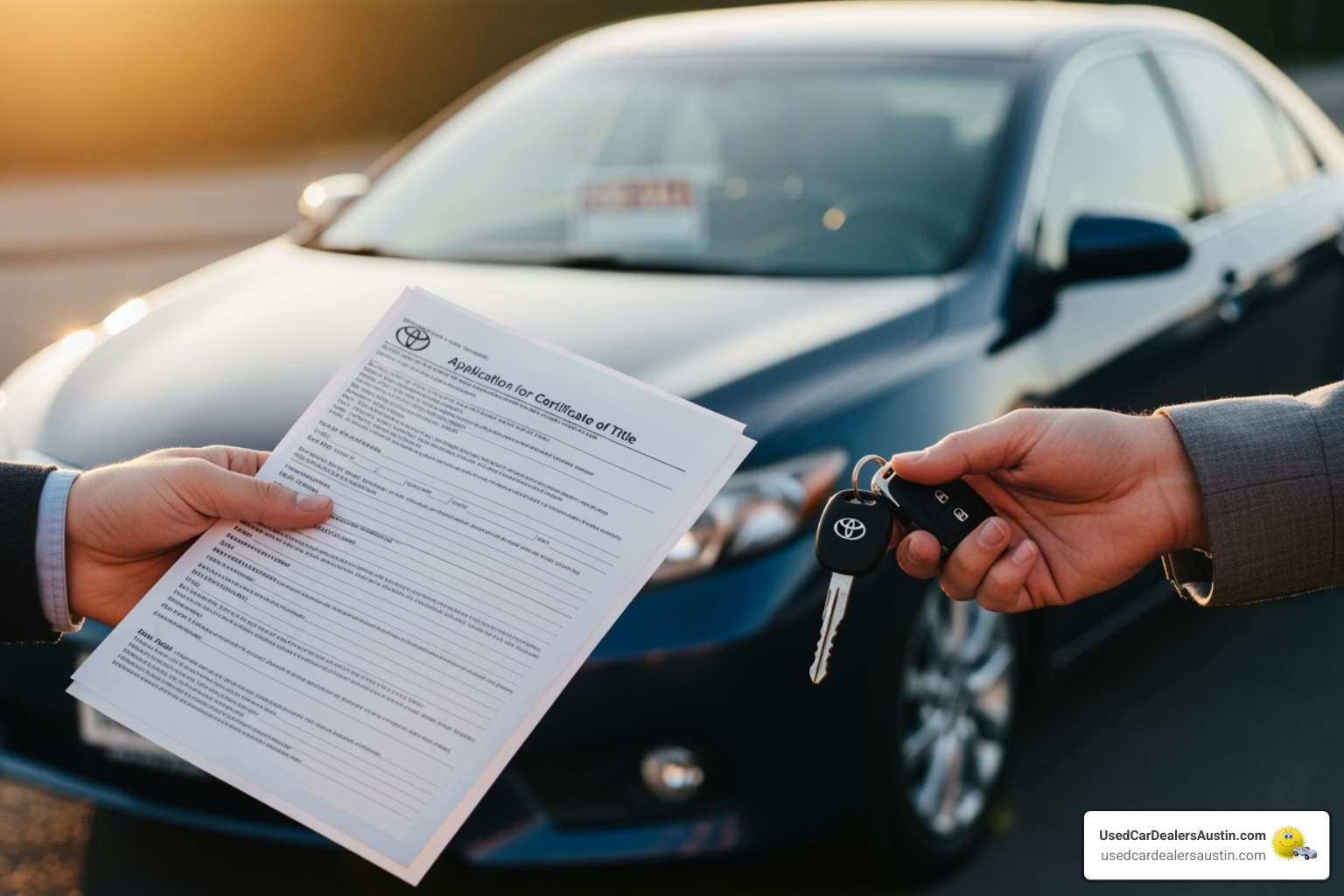
A used car title transfer is the legal process of changing vehicle ownership from the seller to the buyer. This critical step proves you legally own your car and allows you to register, insure, and drive it without issues.
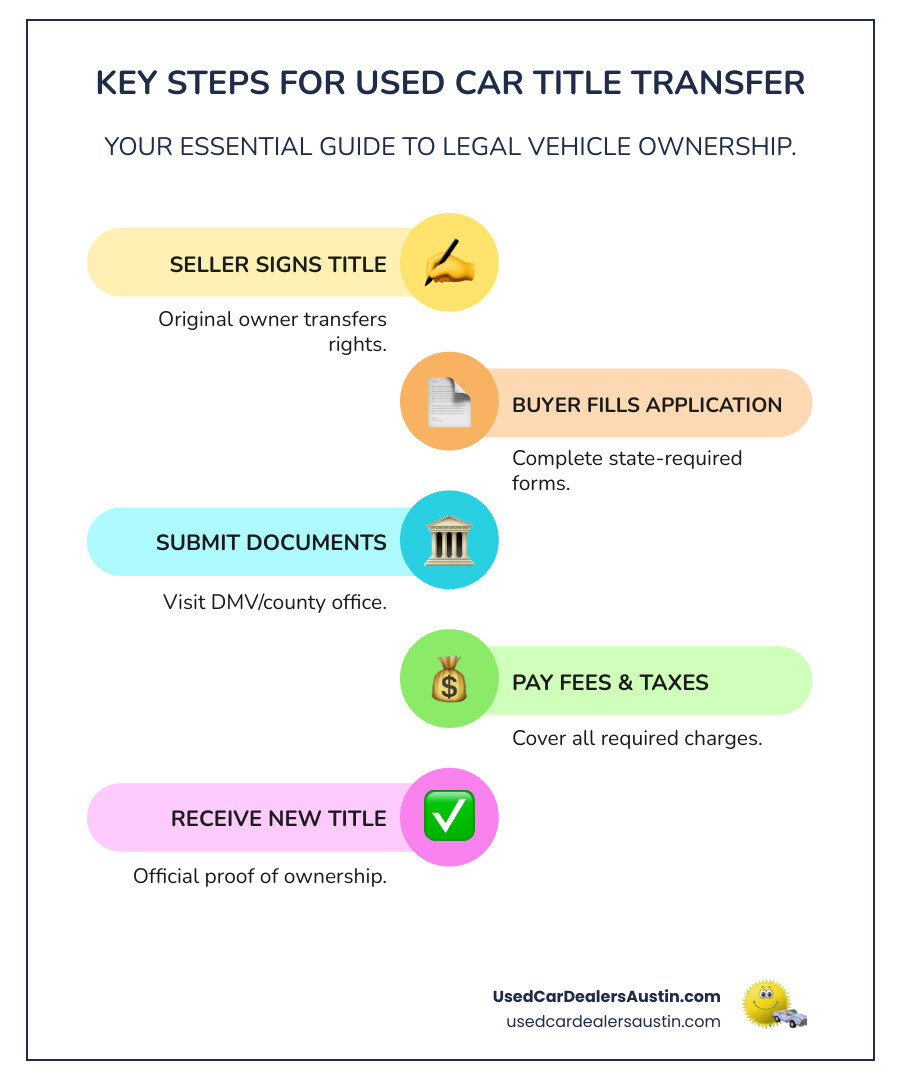
Key Steps for Used Car Title Transfer:
- Seller signs the title – Original owner signs over ownership rights
- Buyer completes application – Fill out state-required forms (like Texas Form 130-U)
- Submit documents – Visit DMV or county office with required paperwork
- Pay fees and taxes – Cover title transfer, registration, and sales tax
- Receive new title – Get official proof of ownership in your name
Without proper title transfer, you can’t legally register your vehicle or get insurance coverage. In Texas, you have just 30 days to complete the transfer or face penalties.
The process involves specific documents like the certificate of title, bill of sale, proof of insurance, and government-issued ID. Each state has different requirements – Texas charges 6.25% sales tax, while California requires smog inspections.
Most buyers worry about the paperwork, but understanding the basics makes it straightforward. Whether you’re buying from a dealer or private seller, the core steps remain the same.
The Core Paperwork: Documents You Can’t Do Without
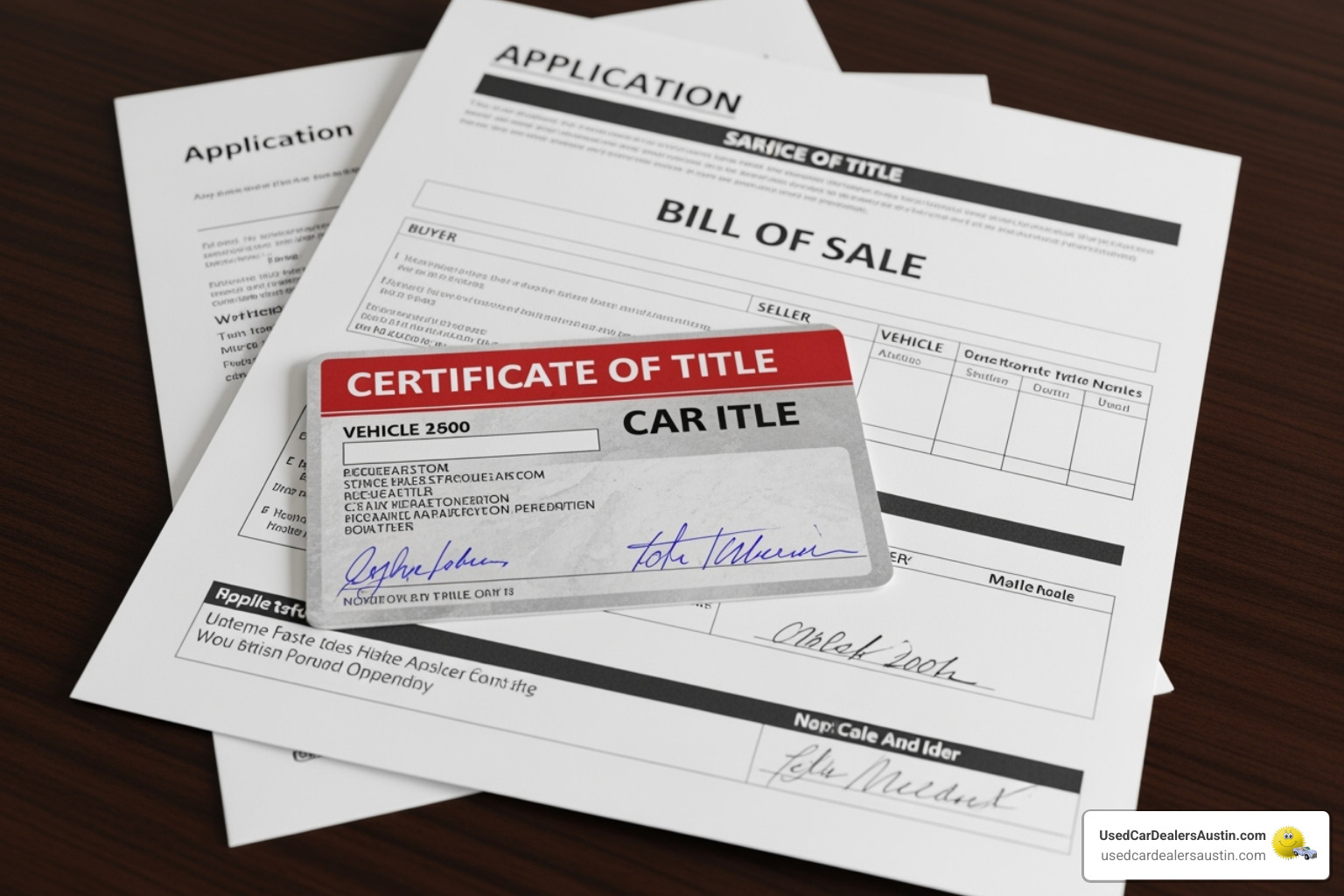
Getting the paperwork right for your used car title transfer is like following a recipe – miss an ingredient, and the whole thing falls apart! The good news? Once you know what documents you need, the process becomes much smoother.
The Certificate of Title is your most important document. This official paper proves who legally owns the vehicle and contains everything from the VIN number to the make, model, and year. Think of it as the car’s birth certificate – without it, you can’t prove ownership.
Your Bill of Sale might not be legally required everywhere, but it’s your safety net. This document records all the sale details, including the price, date, and both parties’ signatures. It protects everyone involved and creates a clear paper trail of the transaction.
The Odometer Disclosure prevents mileage fraud and keeps everything transparent. In Texas, you’ll need this for any vehicle under 20 years old. Usually, there’s a section right on the title where you record the exact mileage at the time of sale.
Before you can complete your used car title transfer, you’ll need Proof of Insurance in your name. Texas requires liability coverage that meets state minimums, and you can’t register your vehicle without it. Need help finding the right policy? Our guide on How to Find the Right Insurance Coverage for Your Used Car has you covered.
Both buyer and seller need a valid Government-Issued ID like a driver’s license. The DMV needs to verify everyone’s identity during the transfer process.
In Texas, you’ll also need the Application for Texas Title and/or Registration (Form 130-U). This form makes the ownership change official and legal. You can download it from the Application for Texas Title and/or Registration (Form 130-U) page.
Seller’s Responsibilities
As the seller, you’re handing over more than just keys – you’re transferring legal ownership. Signing the title correctly is your biggest responsibility. Use black or blue ink, write clearly, and never use white-out or make corrections that could invalidate the document.
You need to provide all necessary documents to the buyer. This includes the title, any lien release paperwork if you had a loan, and a complete bill of sale with all the transaction details.
Here’s something unique to Texas: you must remove your license plates when you sell. Unlike some states where plates stay with the car, Texas plates belong to the owner, not the vehicle.
Notifying the DMV about the sale protects you from future liability. Texas offers an online vehicle transfer notification service that officially records when the car left your possession. If you had a loan on the vehicle, getting a lien release document from your lender proves the car is paid off and ready for transfer.
Buyer’s Responsibilities
Congratulations on your new wheels! Your job is making sure everything checks out before you become the legal owner. Start by inspecting all documents carefully. The VIN on the title must match the VIN on the actual vehicle – any mismatch is a serious red flag.
Verifying the VIN takes just a minute but can save you from major headaches later. Check the dashboard, driver’s side door jamb, and title to make sure all the numbers align perfectly.
You’ll need to secure car insurance before completing the transfer. This isn’t just smart – it’s required. Your Car Insurance must be active and in your name before you can register the vehicle.
Completing the application means filling out every section of Form 130-U accurately. Take your time and double-check everything – mistakes can delay the whole process.
Finally, be ready for paying fees and taxes. Texas charges title transfer fees, registration costs, and 6.25% sales tax on the purchase price. Having these costs calculated ahead of time prevents any surprises at the county office.
The Step-by-Step Used Car Title Transfer Process

Alright, you’ve got your paperwork mountain organized – now let’s make it official! The used car title transfer process might seem intimidating, but think of it as following a recipe. Get the steps right, and you’ll have that sweet taste of legal ownership.
Here’s the deal: while some places offer fancy online transfer options (Quebec’s SAAQclic system lets you transfer vehicles with just a few clicks!), Texas keeps things more traditional. The seller can handle their notification online, but as the buyer, you’ll need to show up in person to seal the deal.
Your destination? The local DMV or County Tax Office. These government offices are where the ownership magic happens. But here’s the kicker – timing is everything! Texas gives you exactly 30 days from the purchase date to complete your transfer. Miss that deadline, and you’ll be looking at penalties that’ll make your wallet cry.
Finalizing the Sale and Signing the Title
This is where the handshake becomes legally binding. Both parties need to get their signatures just right, because one little mistake can send you back to square one.
The seller signs the title in the “Assignment of Title” section – this is them officially saying “this car isn’t mine anymore.” They’ll also record the odometer reading at the time of sale, which is required in Texas for any vehicle under 20 years old.
Now it’s the buyer’s turn to sign, accepting ownership of your new ride. Here’s a golden rule: no white-out or errors allowed. Seriously, the DMV will reject a messy title faster than you can say “oops.” If you mess up, you’ll need the seller to get a duplicate title, and nobody wants that hassle.
Make sure that odometer reading entry is spot-on accurate. This isn’t just bureaucracy – it protects you from odometer fraud. The sales price documentation on your Bill of Sale is equally important since it determines how much sales tax you’ll pay.
How the Buyer Completes the Used Car Title Transfer
Congratulations, you’re in the home stretch! Now it’s time to make yourself the official owner. This part requires a bit of legwork, but you’ve got this.
Start by gathering all your paperwork one more time. Create a checklist: signed title, Bill of Sale, your valid ID, proof of insurance, and that completed Texas Form 130-U. Missing even one document means another trip back, and who has time for that?
Next comes visiting the local county tax-assessor’s office. In Texas, these offices handle all the vehicle title and registration magic. Pro tip: call ahead to see if you need an appointment – it could save you from sitting in a waiting room for hours.
When you submit the application, the clerk will review everything with eagle eyes. They’re looking for completeness and accuracy, so having your ducks in a row pays off here.
Then comes the moment your wallet’s been dreading: paying title fees and sales tax. This includes the title transfer fee plus Texas’s 6.25% sales tax based on your vehicle’s value. It’s not fun, but it’s the price of legal ownership.
Finally, you’ll receive new plates and registration. In Texas, license plates stay with the seller, so you’ll get shiny new ones! You’ll walk out with temporary registration, and your official new title will arrive in the mail within a few weeks. That’s it – you’re now the proud legal owner of your vehicle!
Navigating State-Specific Rules and Special Cases

Here’s where things get interesting (and sometimes a little tricky). Every state has its own personality when it comes to used car title transfer rules. It’s like ordering barbecue across different states – the basics are the same, but each place has its own special sauce!
State-by-state variations can catch you off guard if you’re not prepared. Here in Texas, we keep things relatively straightforward with a 6.25% sales tax on your vehicle purchase. But hop over to California, and you’ll find they require smog checks for most vehicles before you can complete the transfer. Meanwhile, in New Mexico, certain areas require emissions tests every two years.
These differences aren’t just bureaucratic quirks – they’re real requirements that can delay your transfer if you’re not ready for them. The good news? Once you know what to expect in your state, the process becomes much smoother.
Transferring a Title to a Family Member or as a Gift
Family transfers are one of those heartwarming moments where paperwork meets love. Whether you’re passing down the family truck to your teenager or gifting a car to help out a relative, these transfers come with their own special rules and often some nice tax exemptions.
The key difference between gifting vs. selling is crystal clear: no money changes hands in a true gift. In Texas, family gifts are recognized with a special process that saves you from paying the full sales tax. Instead, you’ll pay just a $10 gift tax – quite a bargain compared to the standard rate!
You’ll still need to complete all the required forms for gifts, including the standard Form 130-U and an Affidavit of Motor Vehicle Gift Transfer. Some states require additional documentation like a Sworn Statement for a Family Gift to prove the transfer is legitimate.
The beauty of family transfers is that they’re designed to be easier on your wallet while still maintaining all the legal protections of a proper title transfer.
Handling Inherited or Out-of-State Vehicles
Sometimes life throws us curveballs, and vehicle ownership needs to change due to inheritance or a move across state lines. These situations require a bit more patience and paperwork, but they’re absolutely manageable.
The inheritance process involves proving your legal right to the vehicle. You’ll typically need a death certificate and letters of testamentary or other court documents showing you’re authorized to handle the deceased person’s affairs. Each state handles this differently, so it’s worth checking with your local office about specific requirements.
Out-of-state title transfers are common when you move or buy a vehicle from another state. Your new home state will want to make sure the vehicle meets their standards, which might mean additional inspections. These could include VIN verification to confirm the vehicle’s identity or safety inspections to ensure it meets local requirements.
The process might take a little longer than a standard in-state transfer, but it’s just a matter of crossing all the t’s and dotting all the i’s. Most DMV offices are experienced with these transfers and can guide you through any extra steps needed.
Avoiding Pitfalls: Liens, Fines, and Common Mistakes
Nobody wants their used car title transfer to turn into a nightmare story. Unfortunately, there are some sneaky traps that can catch even the most careful buyers off guard. The good news? Once you know what to watch for, avoiding these pitfalls becomes much easier.
Think of liens, unpaid fines, and paperwork mistakes as the three villains in your car-buying adventure. They’re lurking in the shadows, waiting to pounce when you least expect it. But don’t worry – we’re here to help you spot them before they can cause trouble. For more comprehensive buying advice, check out What to Consider When Buying a Used Car.
The key is knowing what questions to ask, what documents to verify, and what red flags to watch for during the transfer process.
Ensuring a Lien-Free Vehicle Before You Buy
Here’s something that might surprise you: a lien is essentially an IOU attached to a car. When someone takes out a loan to buy a vehicle, the lender places a lien on it as security. This means the bank or credit union has a legal claim to that car until the loan is completely paid off.
If you accidentally buy a car with an active lien, you could inherit that debt – and yes, the lender could potentially repossess your newly purchased vehicle! It’s like buying someone else’s financial headache along with their car.
Performing a lien search is your first line of defense. Many states offer online databases where you can check a vehicle’s VIN for outstanding claims. Quebec, for example, has an excellent system called the Registre des droits personnels et réels mobiliers that makes lien searches straightforward.
The most important document you need from the seller is a lien release letter from their lender. This official document proves the loan has been fully satisfied and the lien has been removed. Think of it as the car’s “freedom papers” – without it, you’re taking a huge risk.
Don’t forget to check for unpaid fines or tickets either. Outstanding parking violations, toll charges, or other vehicle-related debts can complicate your title transfer. The seller should clear these before you complete the purchase.
Common Mistakes in a Used Car Title Transfer
Even well-meaning buyers and sellers make mistakes that can derail a used car title transfer. Let’s talk about the most frequent slip-ups so you can avoid them.
Incomplete forms are probably the most common problem we see. People rush through the paperwork and leave sections blank, thinking they’ll come back to them later. The DMV doesn’t play that game – every required field needs to be filled out completely and accurately.
Missing signatures can turn your quick DMV visit into multiple trips. Both buyer and seller need to sign in the correct spots, and if there’s a lienholder involved, they need to sign too. Double-check every signature line before you leave the seller.
The incorrect odometer reading catches many people off guard, especially in Texas where it’s required for vehicles less than 20 years old. Write down the exact mileage shown on the dashboard – no rounding up or estimating allowed.
Delaying the transfer is a costly mistake that happens more often than you’d think. Life gets busy, and suddenly that 30-day Texas deadline has come and gone. Late transfer penalties can add up quickly, so mark your calendar and prioritize getting to the county tax office.
Not verifying the seller’s identity might seem overly cautious, but it’s crucial. Make sure the name on their driver’s license matches the name on the title exactly. You want to be absolutely certain you’re buying from the legal owner, not someone who’s trying to sell a car that isn’t theirs.
The biggest mistake of all? Not checking for liens thoroughly enough. This oversight can lead to serious financial and legal complications down the road. Always insist on seeing that lien release letter, and don’t be afraid to verify it with the lender directly if something seems off.
Frequently Asked Questions about Used Car Title Transfers
Let’s be honest – even after reading through all this information, you probably still have some burning questions about the used car title transfer process. Don’t worry, that’s completely normal! We’ve been helping folks in Austin steer these waters for years, so let’s tackle the most common questions we hear.
How much does a title transfer cost?
Ah, the million-dollar question! Well, not quite a million dollars, but the costs can add up. The good news is that once you know what to expect, there won’t be any nasty surprises at the county tax office.
Here in Texas, you’re looking at a $33 title fee as your starting point. Then you’ll need to budget around $80 for registration and another $15 for your new license plates. Texas plates stay with the seller, so you’ll definitely need new ones!
But here’s where it gets interesting – the sales tax is usually your biggest expense. Texas charges 6.25% based on your vehicle’s value. So if you’re buying a $15,000 car, that’s about $938 in sales tax. Ouch, right?
Now, if you’re lucky enough to be receiving a car as a gift from family, Texas only charges a $10 gift tax instead. That’s quite a difference! Just make sure you have all the proper gift documentation.
One more thing – don’t drag your feet on this process. Late transfer penalties can really sting your wallet if you miss that 30-day deadline. Trust us, it’s not worth the risk!
How long does the title transfer process take?
Great question, especially if you’re eager to officially call that car yours! The timeline really depends on how you handle the process.
When you visit the county tax office in-person (which is required for buyers in Texas), you’ll walk out with your temporary registration and new plates the same day. It’s pretty satisfying to have everything wrapped up right there on the spot!
Your actual title document, however, takes a bit longer. The state typically mails your new title within 2-4 weeks after processing. We know waiting can be tough when you’re excited about your new ride, but that temporary registration keeps you legal on the roads.
If you’re dealing with any complications – like out-of-state transfers or inheritance situations – the process might take a bit longer. But for a straightforward private party sale, you’re looking at getting your paperwork sorted in one visit and your official title in about a month.
Can I transfer a title online vs. in person?
This is probably our most frequently asked question in today’s digital world! Everyone wants to know if they can handle everything from their couch in pajamas.
Here’s the reality: Texas offers some online options for sellers. If you’re selling your car, you can use the TxDMV Online Services to notify the state about the sale. This is actually a smart move because it protects you from future liability once the car leaves your hands.
But for buyers? You’ll need to make that in-person trip to your local county tax office. There’s just no getting around it – they need to verify your documents, check your ID, and process everything face-to-face.
Some places are more advanced with online services. Up in Quebec, Canada, they have SAAQclic where you can complete certain vehicle transfers entirely online. But here in Texas, we’re still doing things the traditional way for buyers.
The silver lining? Once you’re there in person, everything gets handled efficiently. You’re not dealing with mail delays or wondering if your documents got lost somewhere. You submit everything, pay your fees, and walk out knowing it’s all taken care of.
Conclusion
And there you have it! The used car title transfer process doesn’t have to feel like solving a puzzle blindfolded. There are plenty of moving parts, but when you break it down step by step, it’s really just about being organized and following the rules.
The secret sauce to success? Preparation is everything. Get your documents lined up before you need them, verify that every signature is in place, and make absolutely sure all the information matches up perfectly. Trust us, spending an extra few minutes double-checking paperwork now will save you hours of headaches later.
Don’t forget about those pesky deadlines either! Here in Texas, that 30-day window isn’t just a suggestion – it’s the law. Miss it, and you’ll be paying penalties on top of your regular fees. Nobody wants that surprise expense!
We know all this paperwork can feel overwhelming, especially when you’re excited about your new wheels. That’s exactly why we at UsedCarDealersAustin.com make it our mission to handle the heavy lifting for you. We’ve seen every possible title transfer scenario, and we handle all the paperwork so you don’t have to worry about missing a signature or forgetting a form.
Whether you’re buying your first car or your tenth, we’re here to make sure the legal stuff gets done right the first time. After all, you should be spending your time planning road trips, not sitting in government offices!
Ready to get started on your next vehicle purchase? Let us help you Transfer Your Used Car Title without the stress and confusion. We’ve got this covered!