


Blog
Breaking Down the Bad Credit Car Loan Barrier

If you’re wondering how to get a used car loan with bad credit, the good news is that it’s absolutely possible – even with scores as low as 300-500. While bad credit creates challenges, it doesn’t have to stop you from getting the reliable transportation you need.
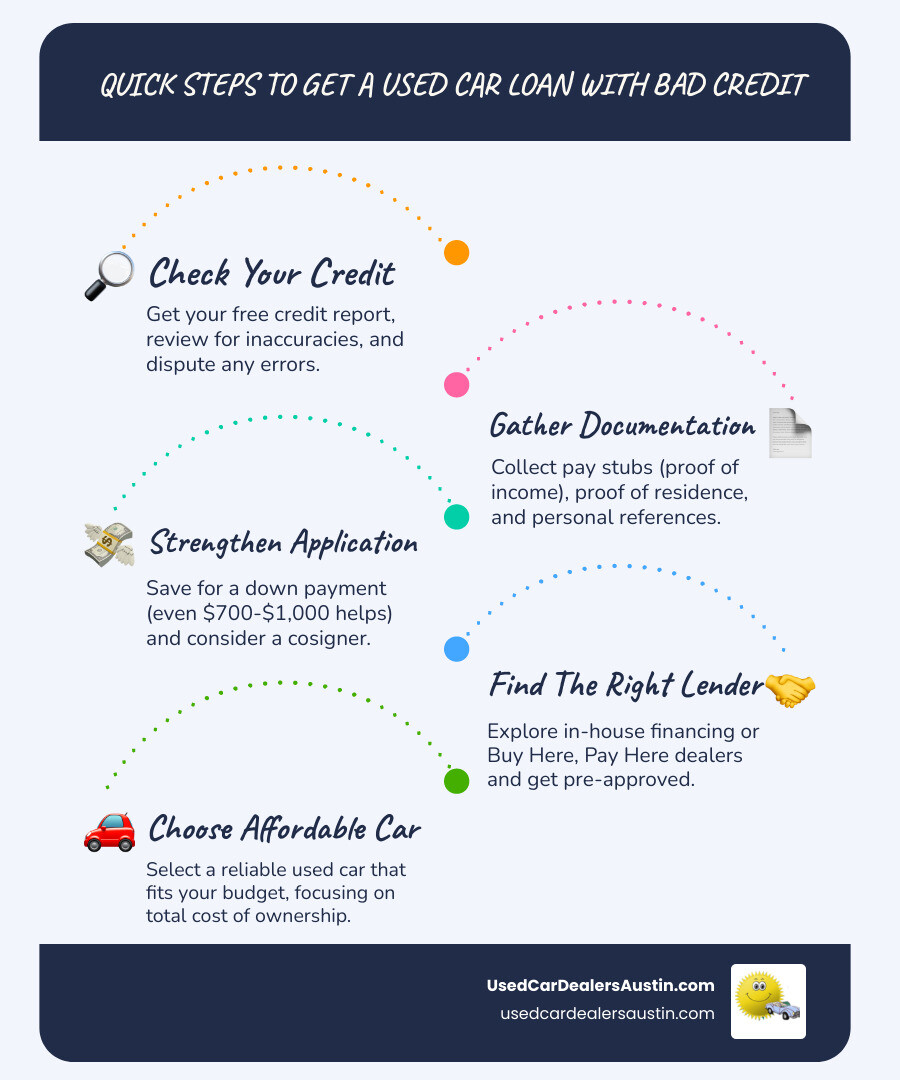
Quick Steps to Get a Used Car Loan with Bad Credit:
- Check your credit – Get your free credit report and fix any errors
- Gather documentation – Pay stubs, proof of residence, and references
- Save for a down payment – Even $700-$1,000 can make a huge difference
- Find the right lender – Consider in-house financing or Buy Here Pay Here dealers
- Choose an affordable used car – Focus on reliability over luxury
The reality is stark: borrowers with subprime credit (501-600) pay an average of 17.78% APR for used cars, while those with deep subprime credit (300-500) face rates around 20.67% APR. Compare that to prime borrowers who enjoy rates of just 6.05%, and you can see why preparation matters.
But here’s what many people don’t realize – your credit score isn’t the only factor lenders consider. Income stability, employment history, and your ability to make a down payment can all work in your favor. In fact, most lenders look for a minimum monthly income of just $1,800 before taxes.
As one recent customer shared: “Everyone else wanted more money down or a co-signer. You helped me when no one else would.” This experience reflects what thousands of Austin residents have finded – the right dealership with in-house financing can make all the difference.
Understanding Bad Credit and Its Impact on Car Loans
Ever heard the term “bad credit” and wondered what it really means, especially when you’re looking for a car? Simply put, it generally refers to credit scores below what traditional lenders consider “prime.” Think of it as your financial report card. When that score is on the lower side, it tells lenders that you might be a bit riskier to lend money to.
Specifically, in auto loans, we often talk about a couple of key credit score ranges:
- Subprime Credit: This is usually for FICO scores between 501 and 600. If your score falls here, you’re in good company! In 2019, about 19% of borrowers had subprime credit. The average interest rate for used cars for this group was around 17.78% APR. It’s certainly not ideal, but getting a loan in this range is quite common.
- Deep Subprime Credit: This is the lowest tier, covering FICO scores from 300 to 500. If this sounds like you, don’t despair! About 19% of borrowers were in this group in 2019 too. However, the average interest rates here are higher, typically around 20.67% APR for used cars.
So, why do these numbers matter when you’re trying to figure out how to get a used car loan with bad credit? The main challenges come down to how lenders see risk. A history of late payments or other financial hiccups suggests a higher chance that the loan might not be paid back on time.
This higher risk translates into a few common problems:
- Higher Interest Rates: This is the big one. As you can see from the statistics above, if you have bad credit, you’ll pay significantly more in interest over the life of the loan. Imagine this: while someone with prime credit might pay an average of just 6.05% APR for a used car, a deep subprime borrower could be looking at over 20%. This difference can add thousands of dollars to the total cost of your vehicle! For instance, on a $20,000, 60-month loan, great credit might mean around $1,996 in total interest. But with poor credit, that could jump to $9,246 in total interest. That’s a huge chunk of change!
- Stricter Loan Terms: Lenders might ask for a larger down payment, offer shorter repayment periods, or limit the total amount you can borrow. These are all ways they try to reduce their risk when lending to someone with a lower credit score.
- Limited Vehicle Selection: You might find that some dealerships or lenders will only finance certain types of vehicles for bad credit borrowers. Often, these are older or less expensive models. This helps keep the loan amount lower and, again, reduces the lender’s risk.
Understanding these challenges is the very first step on your journey to getting a car loan with bad credit. It might seem a bit daunting at first, but knowing what to expect empowers you to steer the process effectively. We truly believe everyone deserves reliable transportation, no matter their credit history. To dive deeper into how your score impacts financing, check out our guide on The Role of Credit Scores in Used Car Financing.
How to Get a Used Car Loan with Bad Credit: A Step-by-Step Guide
Getting a used car loan with bad credit might feel like climbing Mount Everest, but with the right guide and preparation, it’s absolutely achievable! We’re here to break it down into manageable steps, showing you that the car you need is well within reach.
Step 1: Prepare Your Credit and Finances
Before you even think about stepping onto a car lot, the most crucial thing you can do is prepare your financial situation. This proactive approach can significantly improve your chances of approval and potentially secure better terms. Think of it as getting your financial house in order.
First things first: check your credit report. You need to know exactly where you stand. We strongly recommend getting your free reports from all three major bureaus (Experian, TransUnion, and Equifax). You can do this once a week at AnnualCreditReport.com. Why is this so important? Because mistakes happen! You might find inaccuracies or errors that aren’t even yours, and disputing them can sometimes give your score an unexpected boost. If you find errors, don’t just ignore them. The CFPB provides simple, step-by-step guidance on how to identify and dispute incorrect information on your credit report. It can be a little tedious, but it’s totally worth the effort for that potential score improvement!
Next, if you can, pay down debt. One of the quickest ways to improve your credit score is to reduce what you owe, especially on credit cards. Your credit utilization ratio – which is how much credit you’re using versus how much you have available – is a huge factor in your score. Lenders generally like to see this ratio below 30%. Paying down balances shows you’re financially responsible, and that’s a big plus for your score. Also, if you have any accounts that are behind, try to catch up on late payments. Your payment history makes up 35% of your FICO score, so consistent, on-time payments are super important. Even one late payment can have a significant negative impact.
Even if you have no credit history at all, these steps are still important. Building a positive financial footprint is key. Learn more about navigating this journey in our article on Car Loan with No Credit History.
Step 2: Gather Your Documentation
Lenders, especially those working with bad credit, need to verify your ability to repay the loan. Having all your documents ready before you apply shows you’re serious and organized, which can really speed up the approval process. It’s like having all your ingredients measured out before you start baking!

Here’s what you’ll typically need to have on hand:
- Proof of Income: This is critical. Lenders need to see that you have a stable and sufficient income to comfortably cover your monthly car payments. Bring your most recent pay stubs (usually the last two or three months), W-2s, or tax returns if you’re self-employed. Many lenders look for a minimum monthly income of just $1,800 before taxes. This can come from hourly, weekly, bi-weekly, or monthly earnings. We understand income can fluctuate, so bring as much consistent proof as possible.
- Proof of Residence: You’ll need to show that you have a stable place to live. This can be something like a recent utility bill (electricity, gas, water), a lease agreement, or mortgage statements. Lenders often prefer to see that you’ve been at your current address for at least 6-12 months, as it shows stability.
- Valid Driver’s License: This seems obvious, but it’s a must-have! Make sure your license is current and not expired.
- Personal References: Some lenders, particularly buy-here, pay-here dealerships, may ask for a list of personal references. This typically includes their names, addresses, and phone numbers. It’s a way for them to verify your identity and, in some cases, reach out if they can’t contact you directly.
Having these documents neatly organized will make the application process much smoother. For a more comprehensive list of what you might need, check out our Car Financing Requirements page.
Step 3: Strengthen Your Application to get a used car loan with bad credit
Even with bad credit, there are powerful ways to make your application more appealing to lenders. Think of it as putting your best foot forward, even if that foot has a few scuffs. These strategies can significantly improve your chances and potentially get you a better deal on how to get a used car loan with bad credit.
A down payment is arguably one of the most impactful strategies when you have bad credit. Even a few hundred dollars can make a difference, but aiming for 10% or more of the vehicle’s price is ideal. Here’s why it’s so powerful:
- It reduces the loan amount you need, which means less risk for the lender.
- It lowers your monthly payments, making it easier for you to stay on track.
- Lenders may offer improved loan terms, like a lower interest rate, because you’re showing commitment.
- You build equity faster, starting with more ownership in your vehicle.
If you have a friend or family member with good credit who is willing to cosign for you, it can significantly boost your chances of approval and help you secure a better interest rate. A cosigner essentially guarantees the loan, promising to make payments if you can’t. Just remember, cosigner responsibilities are serious. If you miss payments, it negatively affects both your credit and your cosigner’s. So, only consider this option if you are absolutely committed to making on-time payments, to protect your relationship and their credit.
Lenders also love stable employment history. If you’ve been at your current job for at least 6-12 months, it signals reliability. Even if you’ve changed jobs recently, demonstrating consistent employment in the same industry can be a plus. It shows you’re a dependable earner.
Finally, your Debt-to-Income (DTI) ratio is important. This ratio compares your total monthly debt payments to your gross monthly income. Lenders use it to assess your ability to take on new debt. A lower DTI ratio indicates you have more disposable income to cover a car payment. Aim for a DTI below 45%-50% if possible. Keeping your car payment under 20% of your gross income is a good rule of thumb to keep your finances comfortable.
By focusing on these areas, you’re not just asking for a loan; you’re presenting a stronger, more responsible financial profile, which makes it easier for us to help you.
Step 4: Find the Right Lender and Get Pre-Approved
This is where the rubber meets the road! Not all lenders are created equal, especially when it comes to bad credit. Finding the right fit can save you stress and money.
When you’re looking for financing with bad credit, you’ll often hear about a couple of key options. Let’s compare them:
Comparing Financing Options for Bad Credit:
| Financing Option | Pros | Cons |
|---|---|---|
| In-House Financing (e.g., UsedCarDealersAustin.com) | Direct lending from the dealership, making the process much smoother. Often more accessible for bad or no credit because they understand your situation and look at your whole financial picture, not just your score. Quick approval process. Can help build your credit if they report to credit bureaus (which we do!). Wide inventory. | May have higher interest rates than traditional banks for prime borrowers, but generally competitive for bad credit. |
| Buy Here, Pay Here (BHPH) | Very high approval rates for those with poor credit. Convenient one-stop-shop where you buy the car and make payments directly to the dealer. Often the best option for very poor credit or unique financial situations. | Interest rates can be higher due to the increased risk the dealer takes on. Vehicle selection may be limited. It’s crucial to choose a dealer that reports your payments to credit bureaus to ensure you’re building your credit (some don’t, so always ask!). Payments are typically structured for timely repayment. |
At UsedCarDealersAustin.com, we specialize in in-house financing because we believe everyone deserves reliable transportation. This means we are the lender, so we have more flexibility and can work with a wider range of credit situations, including bad credit.
Getting pre-approval is an incredibly important step. It’s like having a special pass that tells you how much you can spend. When you get pre-approved, a lender gives you an estimate of how much they’re willing to lend you, along with the estimated interest rate. This allows you to shop for a car with confidence, knowing your budget upfront. It also means you can focus on finding the right car, rather than worrying if you’ll be approved. It turns the tables, giving you more negotiating power. For first-time buyers navigating these waters, our guide on Used Car Financing for First Time Buyers offers even more insights.