


Blog
Why Understanding Gift Car Title Texas Laws Can Save You Money

Gift car title Texas transfers offer significant savings compared to traditional vehicle sales. Instead of paying the standard 6.25% sales tax, eligible recipients pay only a $10 gift tax when receiving a vehicle from qualifying family members.
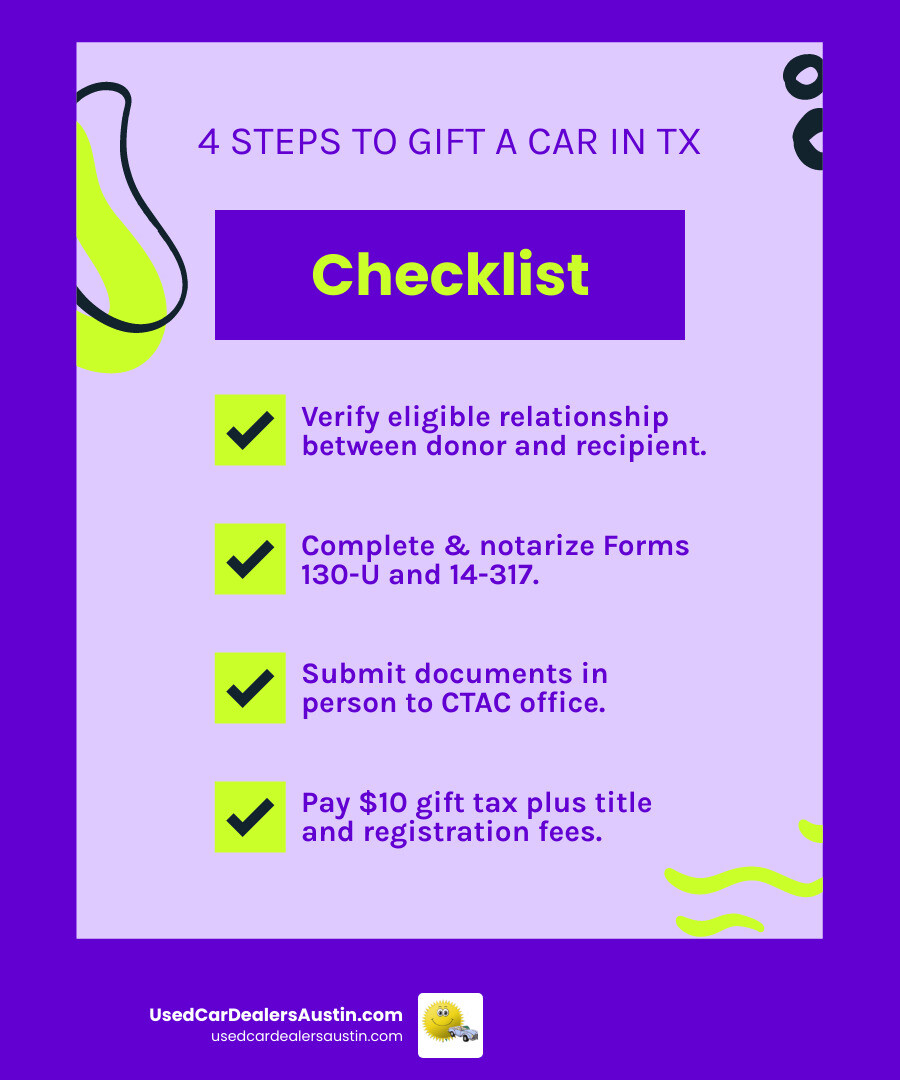
Quick Answer: To gift a car title in Texas, you need:
- Complete Form 130-U (Application for Texas Title and/or Registration)
- Complete Form 14-317 (Affidavit of Motor Vehicle Gift Transfer)
- Have both forms notarized with donor and recipient signatures
- Submit in person to your County Tax Assessor-Collector office
- Pay the $10 gift tax plus title and registration fees
The process requires no money to change hands between eligible parties like spouses, parents, children, siblings, grandparents, or grandchildren. This “no consideration” rule means no cash payments, debt assumptions, or property exchanges.
For many families, this represents substantial savings. A $15,000 vehicle would normally incur $937.50 in sales tax, but when properly gifted to an eligible relative, the tax drops to just $10.
However, the rules are strict. Gifting to ineligible parties like nephews, uncles, or friends automatically converts the transfer to a sale subject to Standard Presumptive Value procedures and full sales tax.
When you’re looking to pass on a vehicle to a loved one, understanding the specifics of a gift car title Texas transfer is crucial. We’re here to guide you through this process, ensuring you steer the legalities smoothly and take advantage of the significant tax benefits available.
Understanding the Basics of a Texas Motor Vehicle Gift
Let’s start with the fundamentals. When it comes to gift car title Texas transfers, the state has very specific rules about what actually qualifies as a “gift.” It’s not as simple as just deciding to give someone your car – there are legal requirements that determine whether you’ll pay the special $10 gift tax or get stuck with the standard 6.25% sales tax.
A true motor vehicle gift means absolutely no consideration changes hands. This “no consideration” rule is stricter than you might think. It means the recipient can’t give you anything of value in return – not even a single dollar.
Here’s what disqualifies a transfer from being considered a gift: cash payment of any amount (yes, even that symbolic $1), debt assumption where the recipient takes over your car payments, exchange of property like trading for another vehicle, or payment for services you provided. The transfer must be completely voluntary with zero expectation of receiving anything back.
Who Are the Eligible Parties for a Motor Vehicle Gift Transfer in Texas?
Texas limits the special $10 gift tax to transfers between specific family relationships. This prevents people from falsely claiming sales as gifts just to dodge taxes. The eligible parties include your spouse (for separate property), parent or stepparent (including in-laws), child or stepchild (including sons and daughters-in-law), siblings (including brothers and sisters-in-law), grandparents and grandchildren (including those related by marriage), legal guardians with proper documentation, and transfers from a decedent’s estate.
The state also allows gifts to qualifying 501(c)(3) organizations and certain revocable living trusts, which we’ll explore in detail later.
Now here’s where many people get surprised: ineligible parties include relationships that feel close but don’t make the official list. Your favorite nephew, beloved uncle, or best friend don’t qualify for gift treatment, no matter how much you care about them.
What Happens If a Motor Vehicle Transfer Without Consideration Does Not Qualify as a Gift?
This is where the rules can really sting your wallet. If you transfer a vehicle to someone outside those eligible relationships – even if no money changes hands – Texas doesn’t consider it a gift for tax purposes.
The consequences of an ineligible transfer mean the recipient faces the full motor vehicle sales tax of 6.25%. The tax gets calculated using the vehicle’s Standard Presumptive Value (SPV) or actual sales price, whichever is higher. So while you might think you’re being generous by “gifting” your car to your nephew, he’ll end up paying hundreds or even thousands in sales tax because the state treats it as a regular sale.
Understanding these rules upfront can save you and your loved ones significant money and frustration. For the most current information and detailed guidelines, check the Official Texas Motor Vehicle Tax Guide directly from the state.
Required Documents for a Gift Car Title Texas Transfer
Getting ready for a gift car title Texas transfer? Let’s talk paperwork. I know, I know—nobody gets excited about forms and documents, but having everything ready beforehand will save you time and frustration at the county office.
The good news is that the document requirements are pretty straightforward. You’ll need the original vehicle title, which is absolutely essential. The donor (that’s the person giving the car) needs to sign the back of this title properly. Think of it as officially saying “I’m passing this car to you.”
For vehicles under ten years old, you’ll also need to record the odometer reading at the time of transfer. This can be done right on the title itself or on a separate odometer disclosure statement—just make sure that mileage is documented accurately.
The recipient needs to bring proof of liability insurance that meets Texas requirements. If they already have insurance on another vehicle, that coverage can work for the first 30 days while everything gets sorted out. Pretty convenient, right?
Both parties should bring a valid government-issued photo ID—nothing expired, please. The county office will need to verify everyone’s identity, and you’ll need to provide full legal names, addresses, and signatures on the various forms.

The Two Essential Forms
Here’s where things get specific. Two forms are absolutely critical for your gift car title Texas transfer, and you can’t skip either one.
First up is the Application for Texas Title and/or Registration (Form 130-U). This workhorse form handles almost every title and registration transaction in Texas. Both the donor and recipient must sign it, and you’ll mark it to show the vehicle is being transferred as a gift. You can download it directly from the state: Application for Texas Title and/or Registration (Form 130-U).
The second form is your ticket to that sweet $10 gift tax: the Affidavit of Motor Vehicle Gift Transfer (Form 14-317). This is where you officially declare that no money or other consideration changed hands. You’ll describe your relationship to each other and certify that this is truly a gift.
Here’s the important part—both the donor and recipient signatures on Form 14-317 must be notarized. That means you’ll need to visit a notary public before heading to the county office, or find one there if they offer notary services. This notarization requirement adds an extra layer of verification that helps protect the $10 gift tax benefit. Get the form here: Affidavit of Motor Vehicle Gift Transfer (Form 14-317).
Make sure every piece of information on both forms is accurate and complete. A small mistake can cause delays, and nobody wants to make multiple trips to the county office. These two forms, along with your properly signed title, are what make the magic happen.
A Step-by-Step Guide to Gifting a Car Title
Ready to make that special delivery? Let’s walk through exactly how to handle a gift car title Texas transfer, step by step. While it might seem complicated at first, the process is actually quite straightforward once you know what to expect.

Here’s something important to remember: you’ve got 30 days from the gift date to complete this entire process. Missing this deadline can lead to penalties, so don’t put it off! The whole process requires an in-person visit to your County Tax Assessor-Collector (CTAC) office – no shortcuts here.
If you’re curious about vehicle ownership transfers in general, our guide on transferring the ownership of a used car covers the broader topic.
Step 1: Prepare the Vehicle Title and Donor Responsibilities
The person giving the car (the donor) has several important tasks to complete first. Think of this as getting the vehicle “release-ready.”
Signing the back of the title is your first priority. The donor needs to complete the “Assignment of Title” section on the back of the original title. This signature legally transfers ownership, so make sure it’s done clearly and matches the name on the front of the title.
Next comes recording the odometer reading accurately on the title. For vehicles less than 10 years old, this step is particularly important as it may require a separate Odometer Disclosure Statement. Don’t guess – check the actual mileage and write it down precisely.
The date of transfer should be clearly written on the title as well. This date starts your 30-day countdown for completing the process.
While not required for gifts, smart donors also submit a Vehicle Transfer Notification to protect themselves. This online notification shields the donor from any future liability like tickets or tolls that might occur after the gift date, especially if the recipient delays completing the title transfer. You can submit a Vehicle Transfer Notification online – it’s free and takes just a few minutes.
Step 2: Complete the Required Gift Car Title Texas Affidavits
Now comes the paperwork that makes your gift car title Texas transfer official. You’ll need both the donor and recipient present for this step since both parties must sign the forms.
Filling out Form 130-U (Application for Texas Title and/or Registration) requires attention to detail. Both the donor and recipient must complete and sign this form together. Double-check that all vehicle information matches the title exactly, and ensure the recipient’s information is accurate since this will appear on the new title.
Filling out Form 14-317 (Affidavit of Motor Vehicle Gift Transfer) is where the magic happens. This form is what qualifies you for that $10 gift tax instead of the much higher sales tax. When describing the relationship, be specific and accurate – write “Parent to Child” or “Grandmother to Granddaughter” rather than just “family.”
The most critical part is certifying no consideration was exchanged. Both parties are swearing under oath that absolutely nothing of value changed hands for this vehicle – no money, no services, no other property, nothing.
Notarizing signatures is absolutely non-negotiable. Both the donor and recipient must sign Form 14-317 in front of a notary public. If one person can’t be present, they can get their signature notarized separately, and a faxed or scanned copy of their notarized portion is usually acceptable.
Step 3: Visit the County Tax Assessor-Collector (CTAC) Office
Time for the official handoff! Finding your local CTAC office is easy – just search online for your county’s tax office. The recipient needs to visit in person, though the donor can come along if they want.
Submitting all documents happens at once, so make sure you have everything: the original assigned title, completed Form 130-U, notarized Form 14-317, proof of liability insurance, and valid photo ID for everyone involved.
The role of the CTAC is to act as the official gatekeeper for your transfer. Their staff will carefully review every document to ensure completeness and accuracy. They’re also responsible for verifying information – they’ll check that the vehicle details match across all forms and confirm that your relationship qualifies for gift treatment.
In some cases, CTAC staff can handle acknowledging signatures on the affidavit instead of requiring formal notarization, but don’t count on this option. It’s always safer to arrive with everything already notarized.
Step 4: Pay the Applicable Fees
The final step is paying the fees, and this is where you’ll really appreciate the gift transfer process.
The $10 Gift Tax is the star of the show – this tiny fee replaces what could be hundreds or even thousands in sales tax. The recipient is responsible for this payment.
You’ll also pay a title application fee of $28 to $33, depending on your county, plus registration fees that typically run around $78.25 for most passenger vehicles, along with any local fees your county might charge.
Let’s put this in perspective: if you were gifting a $20,000 vehicle through a regular sale, the recipient would pay $1,250 in sales tax alone. With a proper gift car title Texas transfer, that drops to just $10. Add in the title and registration fees, and you’re looking at total costs of around $120 instead of over $1,350. That’s real money staying in your family’s pocket!
The whole process usually takes about 30 minutes at the CTAC office once you have all your documents ready. Most people walk out with their new title in hand, officially completing their gift transfer.
Special Circumstances and Considerations
Life isn’t always straightforward, and neither are vehicle transfers. While the basic gift car title Texas process covers most family situations, certain circumstances require special handling and additional documentation.

Whether you’re dealing with inheritance after a loved one’s passing, navigating divorce proceedings, or handling cross-state transfers, understanding these special situations can save you time and ensure everything goes smoothly.
Handling a Gift Car Title Texas Transfer in Cases of Inheritance or Divorce
When life changes unexpectedly, vehicle ownership often needs to change too. Both inheritance and divorce create unique scenarios that still qualify for the beneficial $10 gift tax under the right circumstances.
Inheritance situations can be particularly complex, but they’re definitely manageable. When someone inherits a vehicle without paying for it, this typically qualifies as a gift transfer. The process depends on whether the deceased person left a will.
If there was a will, the Executor or Executrix of the estate becomes the “donor” on Form 14-317. They’ll need to provide documentation like letters testamentary to prove their authority to transfer the vehicle. This person signs all the donor sections of the required forms on behalf of the estate.
When someone dies without a will, Texas provides a different path. You’ll use the Affidavit of Heirship for a Motor Vehicle (Form VTR-262) instead of the standard gift forms. In these cases, the heirs actually sign as both donors and recipients on the appropriate paperwork, which might seem odd but makes legal sense.
Divorce transfers work differently but can still benefit from favorable treatment. When a divorce decree awards a vehicle to one spouse, that certified decree serves as the legal transfer document at the CTAC office. However, if the decree doesn’t specifically mention the vehicle, the spouse whose name appears on the title must properly assign it to the other party.
While divorce transfers aren’t technically “gifts” in the traditional sense, they’re transfers without direct monetary consideration happening at the time of transfer, which often qualifies them for similar treatment.
Gifting a Vehicle to a Non-Profit Organization or from Out-of-State
Sometimes generosity extends beyond family, and sometimes family extends beyond state lines. Both scenarios have their own rules worth understanding.
Charitable giving through vehicle donations can still qualify for the $10 gift tax, but only if you’re donating to a qualifying 501(c)(3) organization. The non-profit must provide proof of their 501(c)(3) status when you complete the transfer. This is a fantastic way to support a cause you care about while keeping transfer costs minimal.
However, if the organization doesn’t have 501(c)(3) status, the state treats the transfer as a sale rather than a gift, meaning you’ll face the full 6.25% sales tax based on the vehicle’s value.
Out-of-state gift transfers follow the same basic rules as in-state transfers. If your generous aunt in Oklahoma wants to gift you her car, and you bring it to Texas, you’ll still pay just the $10 gift tax as long as she meets the eligible relationship requirements.
The process remains the same: complete Form 130-U and Form 14-317, get the signatures notarized, and submit everything to your local CTAC office when you title and register the vehicle in Texas. The fact that the vehicle came from another state doesn’t change the favorable tax treatment for eligible family relationships.
Power of Attorney situations sometimes arise when donors or recipients cannot handle the paperwork personally. A Power of Attorney can sign Form 14-317 on behalf of either the donor or recipient, which provides flexibility for families dealing with health issues or other constraints.
There’s an important distinction to understand: while someone with POA can sign the gift affidavit, they typically cannot file it at the CTAC office. The actual submission usually needs to be done by the donor, recipient, or another authorized person who isn’t acting solely under Power of Attorney authority.
The person with POA must present valid identification and ensure their POA document specifically grants authority for vehicle transactions. This prevents confusion and delays at the CTAC office.
Frequently Asked Questions about Gifting a Car in Texas
Let’s tackle some of the most common questions that come up when folks are navigating a gift car title Texas transfer. These are the real-world scenarios that can trip people up if they’re not prepared.
What’s the difference between gifting a car and selling it for $1?
Here’s where people often get themselves into trouble! You might think selling your car to your daughter for a dollar is basically the same as gifting it, but Texas sees things very differently.
When you sell a vehicle for $1, you’ve technically made a sale. That means your daughter will owe the full 6.25% motor vehicle sales tax. But here’s the kicker – the tax isn’t calculated on that $1 you received. Instead, it’s based on the vehicle’s Standard Presumptive Value (SPV), which is what the state thinks your car is actually worth.
So if your car has an SPV of $12,000, your daughter would owe $750 in sales tax, even though you only received a dollar! Compare that to a proper gift car title Texas transfer to an eligible relative, where she’d pay just $10 in gift tax. That’s a difference of $740 – definitely worth doing the paperwork correctly.
The key difference is that magical phrase “no consideration” – absolutely nothing of value can change hands for it to qualify as a gift.
Can a Power of Attorney (POA) be used for the gift affidavit?
Yes, a Power of Attorney can definitely come in handy for gift transfers, especially when someone can’t be physically present to sign the paperwork.
If you have a valid POA, you can sign the Affidavit of Motor Vehicle Gift Transfer (Form 14-317) on behalf of either the donor or recipient. Maybe grandpa wants to gift his truck to his grandson, but he’s in the hospital and can’t make it to sign documents. His POA can handle the signature requirements.
When you go to the CTAC office, you’ll need to bring your own valid ID plus a copy of the POA document. Make sure that POA specifically gives you authority to handle vehicle transactions – not all POAs are created equal.
Here’s one small wrinkle though: while a POA can sign the forms, some counties prefer that the actual donor or recipient (or another authorized person, not just the POA) be the one to file the paperwork in person. It’s always smart to call your local CTAC office ahead of time to confirm their specific procedures.
What happens if I gift a car to someone who isn’t an eligible relative, like a nephew or a friend?
This is probably the biggest “gotcha” in the whole gift car title Texas process. You might have the best intentions, wanting to help out your favorite nephew or that friend who’s been struggling with transportation, but Texas has strict rules about who qualifies for gift treatment.
If you transfer your vehicle to someone outside those eligible relationships – whether it’s a nephew, uncle, friend, cousin, or anyone else who doesn’t make the cut – the state automatically treats it as a sale, even if no money changes hands.
That means your nephew will be stuck paying the full 6.25% sales tax based on the Standard Presumptive Value. On a $15,000 vehicle, that’s nearly $940 in taxes instead of the $10 gift tax that would apply if he were your son instead of your nephew.
The relationship requirements aren’t just suggestions – they’re hard and fast rules that can cost someone hundreds or even thousands of dollars if ignored. So before you promise that car to someone, double-check that they’re on Texas’s approved list of eligible recipients.
Conclusion
There you have it—your complete roadmap to successfully handling a gift car title Texas transfer! While the process involves several specific steps and requirements, it’s absolutely worth the effort when you consider the incredible savings involved.
The beauty of Texas gift transfer laws lies in their simplicity once you understand the rules. Remember the key ingredients: no consideration changing hands, an eligible relationship between donor and recipient, and those two crucial forms—Form 130-U and the notarized Form 14-317. Follow these guidelines, and you’ll transform what could be a $937 tax bill on a $15,000 vehicle into just $10.
But here’s the thing—precision matters. Cutting corners or misunderstanding the eligibility requirements can quickly turn your intended gift into a taxable sale. That nephew you adore? Unfortunately, he doesn’t qualify. Your best friend who’s like family? The state doesn’t see it that way. Stick to the approved relationships, and you’ll sail through the process smoothly.
The 30-day deadline is real, so don’t let those documents sit on your kitchen counter! Get to your County Tax Assessor-Collector office promptly after completing all the paperwork. Your future self (and your wallet) will thank you.
Of course, not every vehicle transaction needs to be a gift. Maybe you’re looking to upgrade your current ride or need financing options that work with your budget. That’s where we come in! At UsedCarDealersAustin.com, we specialize in making vehicle ownership accessible through our comprehensive in-house financing programs—even if your credit isn’t perfect. We’ve helped countless Austin families find reliable transportation with low down payments and competitive rates.
Whether you’re gifting a car to your college-bound daughter or searching for your family’s next dependable vehicle, we’re here to help. Explore options for your next vehicle or learn more about transferring a used car title. Our team understands both the paperwork side and the practical needs of Austin drivers, and we’re committed to making your automotive journey as smooth as possible.