


Blog
Understanding Your Protection Under Texas Car Warranty Laws

The laws in texas for extended warranties on cars are designed to protect consumers and ensure service contract providers are held to high standards. Purchasing a vehicle is a major investment, and understanding your legal protections is crucial, especially when considering an extended warranty, more accurately called a service contract.
Key Legal Protections:
- Service contracts are regulated by the Texas Occupations Code, Chapter 1304 (Service Contract Regulatory Act)
- Providers must be licensed through the Texas Department of Licensing and Regulation (TDLR)
- Financial backing is required – companies must have insurance policies, bonds, or sufficient net worth to guarantee contracts
- Cancellation rights – you can cancel within 30 days for a full refund, or later for a pro-rated refund
- Mandatory disclosures – contracts must clearly state coverage, exclusions, deductibles, and cancellation policies
- No forced sales – dealers cannot require you to buy a warranty as a condition for financing
- Consumer protection – the Texas Deceptive Trade Practices Act (DTPA) provides remedies if providers engage in misleading practices
These contracts can offer peace of mind against unexpected repair costs, but they aren’t all the same. Texas has specific regulations for service contracts, alongside the state’s Lemon Law for new vehicles and federal laws like the Magnuson-Moss Warranty Act. This guide will break down what you need to know to make an informed decision and protect yourself.
Decoding Car Warranties in Texas: More Than Just a Promise
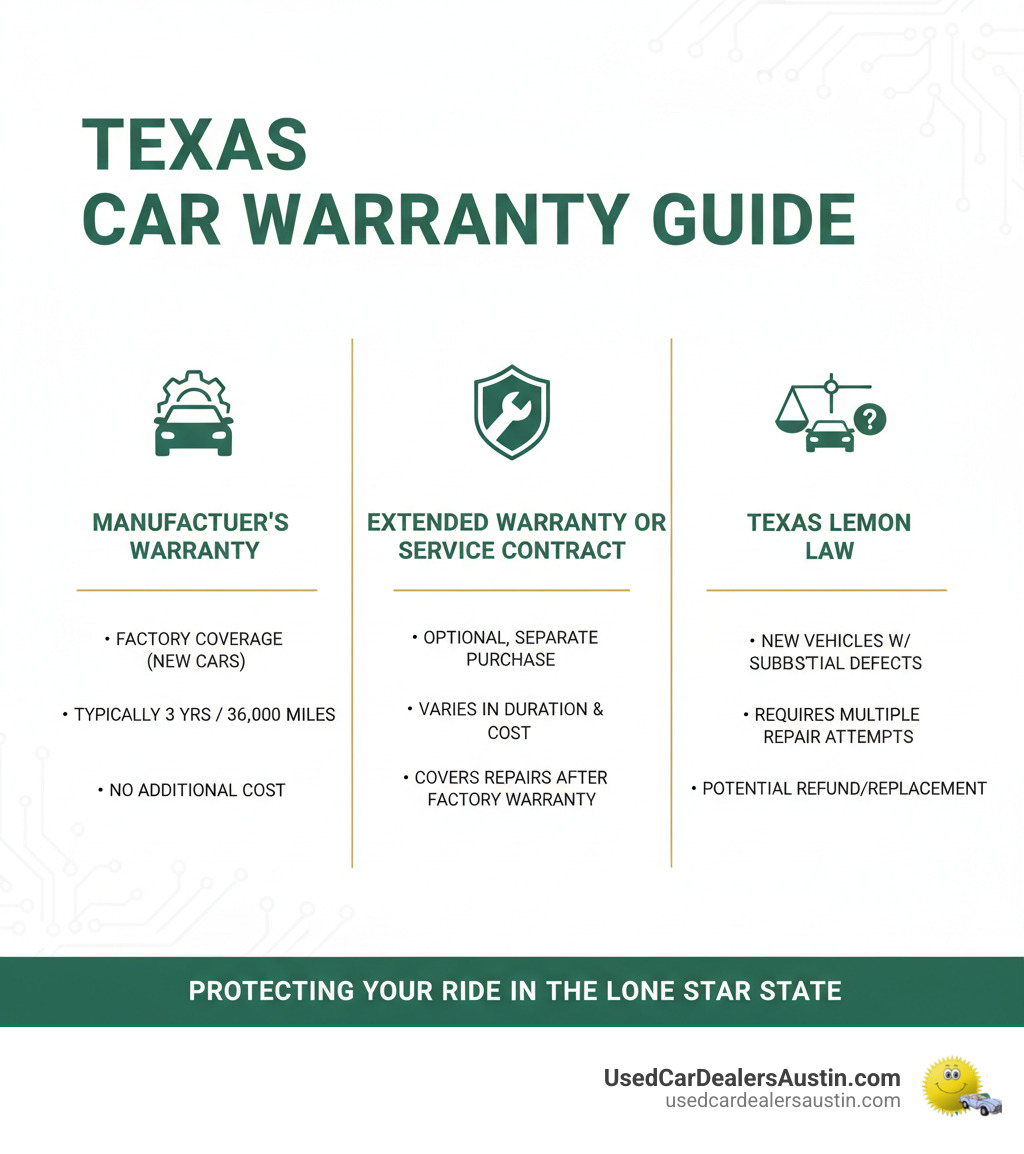
When buying a car, you’ll encounter various warranties. Understanding the difference between a factory warranty and an extended warranty (or service contract) can save you money and frustration. The laws in texas for extended warranties on cars specifically regulate these optional contracts.
Here’s a quick comparison:
| Feature | Manufacturer’s Warranty (Factory) | Extended Warranty (Service Contract) |
|---|---|---|
| Coverage Source | Vehicle manufacturer | Third-party provider, dealership, or manufacturer |
| Cost | Usually included in the vehicle’s purchase price | Additional, separate cost |
| Duration | Limited time/mileage (e.g., 3 years/36,000 miles) from purchase | Begins after factory warranty expires, extends coverage for a specified time/mileage |
| Purpose | Guarantees vehicle is free from defects for a set period | Protects against unexpected repair costs after factory warranty ends |
| Legality | Governed by state and federal warranty laws (e.g., Magnuson-Moss) | Regulated in Texas by the Service Contract Regulatory Act (Texas Occupations Code, Chapter 1304) |
| Transferability | Often transferable | Usually transferable, can increase resale value |
For more details on warranties for pre-owned vehicles, see our More info about used car warranties.
What is an Extended Warranty (Service Contract)?
What most people call an “extended warranty” is legally a service contract in Texas. It’s a promise to pay for specific repairs after your manufacturer’s warranty expires, much like an insurance policy for mechanical parts. You can buy these from manufacturers, dealerships, or third-party providers.
Service contracts offer peace of mind against costly repairs. Coverage can range from powertrain coverage (engine, transmission) to comprehensive bumper-to-bumper coverage that includes electrical systems, A/C, and more. However, coverage, duration, and cost vary widely, making it essential to read the contract details carefully.
Express vs. Implied Warranties Under Texas Law
Beyond service contracts, Texas law provides two automatic warranty types: express and implied.
Express warranties are direct promises from the seller, which can be written (like a manufacturer’s warranty booklet) or verbal (a salesperson stating “the engine is brand new”). As detailed in the Texas Business & Commerce Code on warranties, these statements are legally binding.
Implied warranties are unwritten, automatic protections. The Implied Warranty of Merchantability ensures a vehicle is fit for its ordinary purpose—it runs and drives safely. The Implied Warranty of Fitness for a Particular Purpose applies if a seller recommends a vehicle for a specific need you’ve described, like towing. Sellers can disclaim these in “as-is” sales, but they cannot hide known defects, which may be a violation of the Texas Deceptive Trade Practices Act.
Potential Benefits and Drawbacks
Deciding on a service contract depends on your needs. Here’s a quick look at the pros and cons.
Benefits:
- Peace of Mind: Protection from large, unexpected repair bills.
- Budgeting: Predictable costs (contract price plus deductible) instead of surprise expenses.
- Comprehensive Coverage: Can cover many critical and expensive components.
- Resale Value: A transferable contract can make your vehicle more attractive to future buyers.
Drawbacks:
- Cost: Many people pay more for the contract than they receive in benefits.
- Exclusions: All contracts have a list of non-covered parts and services (e.g., routine maintenance, wear-and-tear items).
- Deductible: You’ll likely pay a deductible for each repair claim.
- Maintenance Requirements: You must follow the manufacturer’s maintenance schedule, or you could void your coverage.
Navigating the Specific Laws in Texas for Extended Warranties on Cars
Texas provides strong consumer protections through the laws in texas for extended warranties on cars. The primary law is the Service Contract Regulatory Act, found in the Texas Occupations Code, Chapter 1304. This act, overseen by the Texas Department of Licensing and Regulation (TDLR), ensures that companies selling service contracts are financially stable and operate transparently.
Provider Requirements: Who Can Sell You a Warranty?
In Texas, not just anyone can sell a service contract. Providers must register annually with the TDLR and prove they are financially stable enough to pay future claims. This is typically done in one of two ways:
- Insuring the contracts through a reimbursement insurance policy, which guarantees coverage even if the provider goes out of business.
- Maintaining a funded reserve account of at least $250,000 (or less for some dealerships) set aside specifically for claims.
Large companies with a net worth over $100 million may be exempt from certain requirements but must still register. This framework protects consumers from companies that might otherwise take their money and disappear.
Key Disclosures Required by Laws in Texas for Extended Warranties on Cars
Texas law mandates that service contracts be transparent. The contract must clearly state all important terms in plain language. Look for these key disclosures:
- Contract Terms: The duration (years/miles) and when coverage begins.
- Coverage and Exclusions: A detailed list of what is and is not covered. This is critical for understanding the limits of your protection.
- Deductible: The out-of-pocket amount you must pay per repair.
- Cancellation Policy: Your right to cancel for a full refund (usually within 30 days) or a pro-rated refund later, minus a fee (capped at $50).
- Claims Process: Step-by-step instructions on how to file a claim.
- Provider and Insurer Information: The identity and contact details for the provider and any backing insurance company.
- Transferability: Whether the contract can be transferred to a new owner.
- Maintenance Requirements: The service schedule you must follow to keep the contract valid.
A contract missing these details is a major red flag.
When Can an Extended Warranty Be Voided?
Understanding what can void your service contract is essential to protecting your investment. Coverage can be denied for several reasons:
- Expired Warranty: The contract has reached its time or mileage limit.
- Excluded Defect: The failed part is on the contract’s exclusion list.
- Lack of Maintenance: Failure to follow the manufacturer’s recommended service schedule. Always keep detailed service records and receipts.
- Unauthorized Alterations: Adding aftermarket parts that cause a failure. Under the federal Magnuson-Moss Warranty Act, the provider must prove your modification caused the specific problem. The FTC has warned companies against voiding warranties due to aftermarket parts without proof.
- Misrepresentation or Fraud: Providing false information when buying the contract or filing a claim.
- Salvage Title: Most contracts do not cover vehicles that have been declared a total loss.
The Texas Lemon Law vs. Your Extended Warranty
When a car has persistent, serious problems, you may be dealing with a “lemon.” The Texas Lemon Law provides a different type of protection than an extended warranty. While a service contract pays for repairs, the Lemon Law can force a manufacturer to buy back or replace a defective vehicle.

What is the Texas Lemon Law?
The Texas Lemon Law, administered by the Texas Department of Motor Vehicles (TxDMV), primarily protects buyers of new vehicles. A used car may only be covered if the defect first appeared and was reported while under the original manufacturer’s warranty.
The vehicle must have a substantial defect that impairs its use, safety, or value. To qualify, you must give the manufacturer reasonable repair attempts, defined by one of these tests:
- Four-Times Test: The same defect has been unsuccessfully repaired four times within the first 24 months/24,000 miles.
- Serious Safety-Hazard Test: A dangerous defect remains after two repair attempts in the same timeframe.
- 30-Day Test: The vehicle is out of service for repairs for 30 days or more within the first 24 months/24,000 miles.
Successful claims can result in a refund, replacement, or final repair of the vehicle. For more, visit the Texas DMV Lemon Law information page.
Coverage Overlap and Gaps
How do the laws in texas for extended warranties on cars and the Lemon Law interact? They serve different purposes. During the manufacturer’s warranty period, the Lemon Law is your strongest tool for a substantially defective new car, offering remedies like a refund or replacement that a service contract can’t.
After the factory warranty expires, your extended warranty takes over. It’s designed to cover post-warranty defects that arise from normal aging. The Lemon Law won’t help with a transmission failure three years after purchase, but your service contract might. They are different tools for different problems.
What if My Defect is Covered by Both?
If a defect could fall under both, strategy is key. If the manufacturer’s warranty is active and the problem is substantial, pursuing a Lemon Law claim is often the best first step. However, using your service contract for a straightforward repair is also an option.
Regardless of the path you choose, follow these steps:
- Document Everything: Keep detailed records of all problems, repair attempts, and days the vehicle was in the shop.
- Notify the Manufacturer: Send a certified letter describing the defect to create a formal record.
- Allow Repair Attempts: Give the dealer a genuine chance to fix the issue.
If you believe you have a lemon, contact the TxDMV to file a complaint. For complex cases, consulting a Texas Lemon Law attorney is advisable.
Enforcing Your Rights: The DTPA and Other Remedies
When disputes arise with a seller or service contract provider, Texas law offers powerful tools to enforce your rights. The laws in texas for extended warranties on cars are backed by strong consumer protection statutes.

The Texas Deceptive Trade Practices Act (DTPA)
The Texas Deceptive Trade Practices-Consumer Protection Act (DTPA) is a consumer’s shield against false, misleading, or deceptive business practices. You can find the full text in The Deceptive Trade Practices Act.
The DTPA applies to warranty issues in several ways:
- Misrepresentation: False statements about a vehicle’s condition or a warranty’s coverage.
- Failure to Disclose: Hiding a known, significant defect, even in an “as-is” sale.
- Unconscionable Actions: Taking grossly unfair advantage of a consumer’s lack of knowledge.
- Breach of Warranty: Failure to honor an express or implied warranty.
If you win a DTPA case, you can be awarded economic damages, damages for mental anguish, and even triple damages for knowing or intentional violations. You can also recover court costs and attorney’s fees, making it feasible to pursue a claim.
Your Rights Under the Laws in Texas for Extended Warranties on Cars if a Provider Fails to Pay
If a provider denies a legitimate claim, you have recourse. Follow these steps:
- Review Your Contract: Double-check that the repair is covered and you’ve met all requirements.
- Send a 60-Day Notice: Before suing, you must send the provider a written notice via certified mail detailing your complaint and damages. This gives them a chance to settle.
- Negotiate: Use the 60-day period to try and resolve the dispute out of court.
- File a Lawsuit: If the issue isn’t resolved, you can sue. For claims under $20,000, you can use a Texas justice court (small claims). For larger claims, you’ll need to file in a district or county court and should retain an attorney. You can seek damages for breach of contract and DTPA violations.
Where to File a Complaint
Filing a formal complaint can help resolve disputes. Here are the key agencies:
- Texas Attorney General’s Consumer Protection Division: For complaints about deceptive trade practices. File online at the Texas Attorney General website.
- Texas Department of Licensing and Regulation (TDLR): For complaints against service contract providers regarding licensing or regulatory violations.
- Texas Department of Motor Vehicles (TxDMV): The primary contact for issues related to the Texas Lemon Law.
- Federal Trade Commission (FTC): For reporting patterns of fraud or deceptive practices. File a complaint at Federal Trade Commission (FTC).
Smart Buying: Best Practices for Purchasing an Extended Warranty in Texas
Knowing how to shop for a service contract is as important as understanding the laws in texas for extended warranties on cars. Follow these best practices to make an informed decision.
-
Read the Fine Print: Every contract is different. Carefully review what’s covered, what’s excluded, the deductible, and your maintenance obligations. A reputable provider will gladly clarify any confusing terms.
-
Research Your Vehicle: Check reliability ratings from sources like Consumer Reports. If your car is known for being dependable, a contract might be unnecessary. If it has known expensive issues, coverage could be a wise investment.
-
Consider Your Ownership Plans: If you plan to keep the car for many years, a service contract can provide valuable long-term protection. For short-term ownership, it may not be cost-effective.
-
Get Multiple Quotes: Compare offers from the manufacturer, the dealership, and third-party providers. Look at price, coverage levels, and deductibles to find the best value.
-
Verify the Provider’s License: Before buying from a third-party provider, confirm they are licensed with the Texas Department of Licensing and Regulation (TDLR). This ensures they meet state financial requirements.
-
Understand Exclusions: This is critical. Make a list of your vehicle’s most expensive potential repairs and check if they are covered. Don’t pay for a policy that excludes the problems you’re most likely to face.
-
Ask About Transferability: A contract that can be transferred to the next owner can increase your car’s resale value and make it easier to sell.
-
Know the Claims Process: Understand how to file a claim, what paperwork is needed, and whether you can choose your own repair shop. Knowing this upfront prevents future headaches.
-
Don’t Be Pressured: Texas law prohibits a dealer from requiring you to buy a service contract to get financing. If you feel pressured, that’s a red flag. You have the right to decline.
-
Keep Meticulous Records: Store your contract, maintenance receipts, and all repair orders in a safe place. This documentation is your best asset if you ever need to file a claim or dispute a denial.
Frequently Asked Questions about Texas Car Warranty Laws
We often get questions about the laws in texas for extended warranties on cars. Here are answers to some of the most common ones.
Are used cars covered by the Texas Lemon Law?
Generally, the Texas Lemon Law applies to new vehicles. However, a used car can be covered if a substantial defect was first reported to the dealer or manufacturer while the vehicle was still under its original manufacturer’s warranty, and the problem continues to exist. The key is that the issue started and was documented during the original warranty period.
Can a dealer require me to buy an extended warranty to get financing?
No. It is illegal in Texas for a dealer to make financing approval conditional on the purchase of an extended warranty or service contract. Your loan approval should be based on your credit and the vehicle, not on buying extra products. If a dealer pressures you this way, you should walk away and consider reporting them to the Texas Attorney General.
How do I cancel an extended warranty in Texas?
You have the right to cancel a service contract. The process is outlined in your contract documents.
- Within the first 30 days, you can typically cancel for a full refund with no cancellation fee.
- After 30 days, you can still cancel and receive a pro-rated refund based on the remaining time or mileage on the contract. The provider may charge a cancellation fee, which is capped by law (usually around $50).
To cancel, notify the provider in writing, preferably by certified mail, to create a paper trail.
Conclusion: Drive with Confidence
Understanding the laws in texas for extended warranties on cars empowers you to protect your investment. You now know the difference between factory warranties and service contracts, the importance of disclosures and financial backing, and your rights under powerful consumer protection laws like the Texas Lemon Law and the DTPA.
You know that you cannot be forced to buy a service contract to get financing, and you have clear cancellation rights. Most importantly, you know where to turn if a provider doesn’t hold up their end of the bargain.
At UsedCarDealersAustin.com, we believe in building relationships through trust and transparency. We’re here to help you find a reliable vehicle and steer your warranty and financing options with honesty, even if your credit isn’t perfect. We want you to drive off our lot with confidence.
Armed with this knowledge, you can make smart decisions, hold providers accountable, and enjoy the road ahead. Ready to find your next vehicle? Explore our comprehensive guide to used car warranties to learn more, then browse our inventory to find your perfect ride.