


Blog
Why Getting Your Texas Transfer Title Application Right Matters

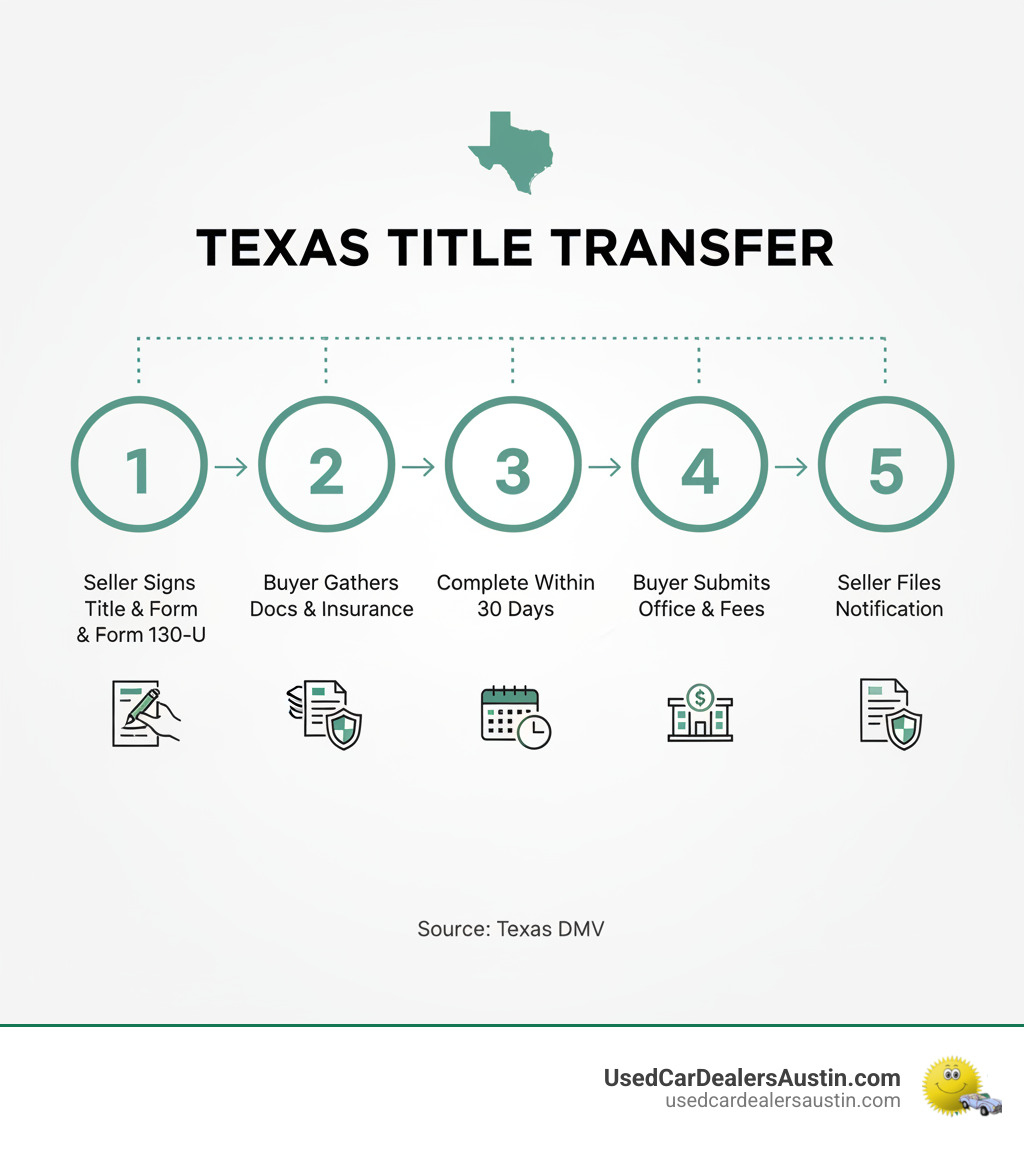
The texas transfer title application process in Texas requires specific forms and strict deadlines to legally transfer vehicle ownership. Here’s what you need to know:
Key Requirements for Texas Title Transfer:
- Form 130-U – Application for Texas Title and/or Registration (signed by both parties)
- Original vehicle title – properly signed and dated by seller
- Proof of insurance – current liability coverage required
- Government-issued photo ID – for buyer identification
- 30-day deadline – from date of sale to avoid penalties
When you buy a used car in Texas, the clock starts ticking immediately. State law requires that all necessary documents for title and registration be filed within 30 days from the date of sale to avoid penalties. Miss this deadline, and you could face late fees starting at 5% of the tax owed.
The process involves two critical players: the seller must properly sign over the title and complete their portion of Form 130-U, while the buyer must file the application with the county tax office, pay applicable fees, and provide proof of insurance.
Failing to properly transfer a vehicle title can leave sellers responsible for tickets, toll violations, or even crimes committed with the vehicle – making it essential for both parties to understand their responsibilities.
Whether you’re buying from a dealer (who handles the paperwork) or an individual (where you’re on your own), understanding these requirements protects both your wallet and your legal standing.
The Core Documents for a Texas Title Transfer
Getting your paperwork right is the foundation of a smooth texas transfer title application. Think of it like baking a cake – you need all the right ingredients before you can create something perfect. Miss one key document, and your whole transfer could crumble faster than a cookie left out in Texas heat!

The good news? There are really just a handful of essential documents you need to gather. Both the seller and buyer have specific responsibilities here, and knowing exactly what’s expected can save you from those dreaded trips back to the county office.
As the seller, your job is to provide clean, accurate paperwork that tells the complete story of your vehicle. You’re essentially handing over the keys to someone’s next adventure, so everything needs to be crystal clear.
For buyers, you’ll need to prove you’re ready to take on the responsibility of vehicle ownership. This means having your identification ready and showing you can financially handle owning a car in Texas.
The proof of insurance requirement isn’t just a suggestion – Texas law demands it before you can register your vehicle. Your insurance policy needs to meet the state’s minimum liability coverage requirements.
Don’t forget your government-issued ID either. The name on your identification must match exactly what goes on the title application. Even a simple nickname difference can cause delays.
Completing the Texas Transfer Title Application (Form 130-U)
Form 130-U is where the magic happens for your texas transfer title application. This single document handles both your title transfer and vehicle registration, making it the Swiss Army knife of Texas vehicle paperwork.
The seller’s signature goes on line 22, which officially releases their ownership of the vehicle. They also need to write down the sales price on line 21 – and yes, this needs to be accurate because it determines how much sales tax you’ll pay.
As the buyer, you’ll be filling out most of the form with your personal information. Your buyer signature on line 24 makes it official that you’re accepting ownership of this vehicle.
The odometer reading is crucial for vehicles less than 10 model years old. This protects everyone involved from odometer fraud and ensures the vehicle’s history stays accurate.
Make sure that Vehicle Identification Number (VIN) is copied perfectly from the vehicle. This unique 17-character code is how Texas tracks your specific car, truck, or SUV through its entire life in the state.
One tiny mistake on this form can delay your transfer by weeks, so take your time and double-check everything. You can Download form 130-U directly from the official TxDMV website to get started.
The Original Vehicle Title
The physical title certificate is like the deed to your house – it’s the official proof of who owns the vehicle. Without a properly signed title, your transfer simply cannot happen.
The seller must sign the back of the title in the designated assignment area. This signature is their legal declaration that they’re transferring ownership to you.
The date of sale written on the title starts your 30-day countdown clock for completing the transfer. Make sure this date is accurate and clearly written.
Any open liens must be resolved before the transfer can happen. If there’s still money owed on the vehicle, the lender needs to release their claim first. When you buy from us, we handle all the lien paperwork so you don’t have to worry about these complications.
The odometer disclosure on the title must match what’s written on Form 130-U. For vehicles under 10 years old, this reading helps maintain the vehicle’s history and protects against fraud.
A clean, properly completed title makes everything else fall into place smoothly. For more detailed guidance on this process, check out our comprehensive guide on How to Transfer Used Car Ownership in Texas.
The Texas Transfer Title Application Process: A Step-by-Step Guide
Now that you’ve gathered all your documents, it’s time to dive into the actual texas transfer title application process. Think of this as the home stretch – you’re almost there, but timing is everything.
Here’s the deal: Texas gives you exactly 30 days from the date of sale to get everything filed. Miss this deadline, and you’ll start racking up penalties faster than you can say “Lone Star State.” We’re talking about a 5% penalty if you’re 1-30 days late, and it jumps to 10% (with a minimum $1 charge) if you’re more than 30 days behind. Nobody wants to pay extra fees for procrastinating!
The good news? Your local County Tax Assessor-Collector office is your one-stop shop for getting this done. These folks handle most vehicle title and registration services throughout Texas, and they know the process inside and out.

The experience you’ll have depends a lot on where you bought your vehicle. When you buy from a private individual, you’re handling everything yourself – from paperwork to payments. But when you purchase from a licensed dealership like us, we take care of the heavy lifting for you.
| Feature | Buying from an Individual (Private Sale) | Buying from a Dealership (Like UsedCarDealersAustin.com) |
|---|---|---|
| Paperwork Handling | You handle all forms and submissions yourself | Dealership handles all paperwork and submissions for you |
| Timeline Responsibility | You must meet the 30-day deadline independently | Dealership ensures timely processing within legal requirements |
| Payment Process | You pay taxes and fees directly at county office | Dealership collects and remits all taxes and fees on your behalf |
| Error Risk | Higher chance of mistakes due to unfamiliarity with process | Professional handling minimizes errors and delays |
| Convenience Level | Multiple trips to county office may be required | One-stop shopping experience with financing and title work handled together |
For the Buyer: Taking Ownership
When you’re the buyer in a texas transfer title application, you’re stepping into the driver’s seat – literally and figuratively. This is where you make that vehicle legally yours in the eyes of Texas law.
Filing the application is your first major step. You’ll head to your County Tax Assessor-Collector office with your properly signed title and completed Form 130-U. If you bought from a private seller, we strongly recommend bringing them along. Trust us on this one – having the seller there can save you from headaches if questions come up or if there’s a signature issue.
Paying taxes and fees is where things get real. You’ll face a $2.50 transfer fee to move the current registration into your name. The bigger expense is the motor vehicle sales and use tax at 6.25% of the vehicle’s sales price (minus any trade-in value). New Texas residents bringing a vehicle from another state pay a $90 use tax instead. Got a gifted vehicle? You’re looking at a $10 gift tax under most circumstances.
Providing proof of insurance isn’t optional – it’s the law. You must show current liability insurance coverage before you can register your vehicle. No insurance, no registration. It’s that simple.
Vehicle inspection requirements vary by where you live. If you’re in one of the 17 counties requiring emissions testing, you’ll need a passing emissions inspection (though safety inspections might not be required). Commercial vehicles need passing commercial inspections no matter which county you call home.
Once everything’s submitted and paid, you can Register your vehicle and hit the road legally!
For the Seller: Releasing Ownership
As the seller, your role in the texas transfer title application process is crucial, but thankfully straightforward. Think of yourself as passing the torch – you need to officially let go of ownership so the buyer can take over.
Signing the title correctly is your most important task. You’ll sign the back of the title in the designated seller section, making sure your signature matches the name on the front. This signature is your official declaration that you’re transferring ownership to the buyer.
Providing Form 130-U requires your attention too. You’ll complete the seller portions, including the sales price and your signature on line 22. Be honest about the sales price – it affects the buyer’s tax calculation, and discrepancies can cause problems down the road.
Removing license plates is something many sellers forget. In Texas, license plates stay with the owner, not the vehicle. Take them off before handing over the keys, or you might find yourself dealing with toll violations and parking tickets you didn’t earn.
The smartest thing you can do as a seller? Accompany the buyer to the county office when they file their paperwork. It shows good faith, and if any issues pop up with signatures or information, you’re right there to resolve them. For more detailed guidance on this process, check out our resource on Transfer the Ownership of a Used Car.
For the Seller: Releasing Ownership
As a seller, your responsibilities don’t end the moment you hand over the keys and collect your payment. Think of it this way: until you properly complete your part of the texas transfer title application process, you’re still legally connected to that vehicle. And trust me, you don’t want to be on the hook for someone else’s speeding tickets or parking violations!
Properly releasing ownership is your insurance policy against future headaches. Here’s what you absolutely need to get right:
Signing the Title is the most critical step you’ll take. You must sign the back of the original vehicle title in the designated area – this is your official declaration that you’re transferring ownership to someone else. Don’t rush through this part! Make sure you accurately fill in the date of sale and record the odometer reading if the vehicle is less than 10 model years old.
One detail that trips up many sellers: the buyer’s name on the title must match their identification exactly. If there’s even a small discrepancy, it could cause delays or complications down the road.
Providing Form 130-U is equally important for your texas transfer title application. You’re responsible for completing your specific portion of the Application for Texas Title and/or Registration. This means signing on line 22 and clearly stating the actual sales price on line 21. Hand this completed form over to the buyer along with the properly signed original title.
Removing License Plates is something many sellers forget about, but it’s actually a smart move. You have the option to remove your license plates and registration sticker from the vehicle before the buyer drives away. You can transfer these plates to a new vehicle if the classification is the same, keep them for future use (though you’ll need a new sticker), or dispose of them properly by defacing them to prevent fraudulent use.
Most experienced sellers prefer to remove their plates immediately. It’s one more layer of protection that helps ensure a clean break from the vehicle.
By taking care of these steps, you’re protecting yourself and making the process smoother for the buyer. For a more detailed walkthrough of this entire process, check out our comprehensive guide on how to Transfer the Ownership of a Used Car.
Seller Protection: The Vehicle Transfer Notification
Picture this: you’ve sold your car, shaken hands with the buyer, and watched them drive away into the sunset. You’re done, right? Not quite. There’s one more crucial step that could save you from a world of headaches down the road.
The Vehicle Transfer Notification (Form VTR-346) is your insurance policy against becoming responsible for what happens after you sell your vehicle. Think of it as officially telling the state, “Hey, this car isn’t mine anymore!” It’s a simple form that alerts the Texas Department of Motor Vehicles (TxDMV) that you are no longer the owner of the vehicle.
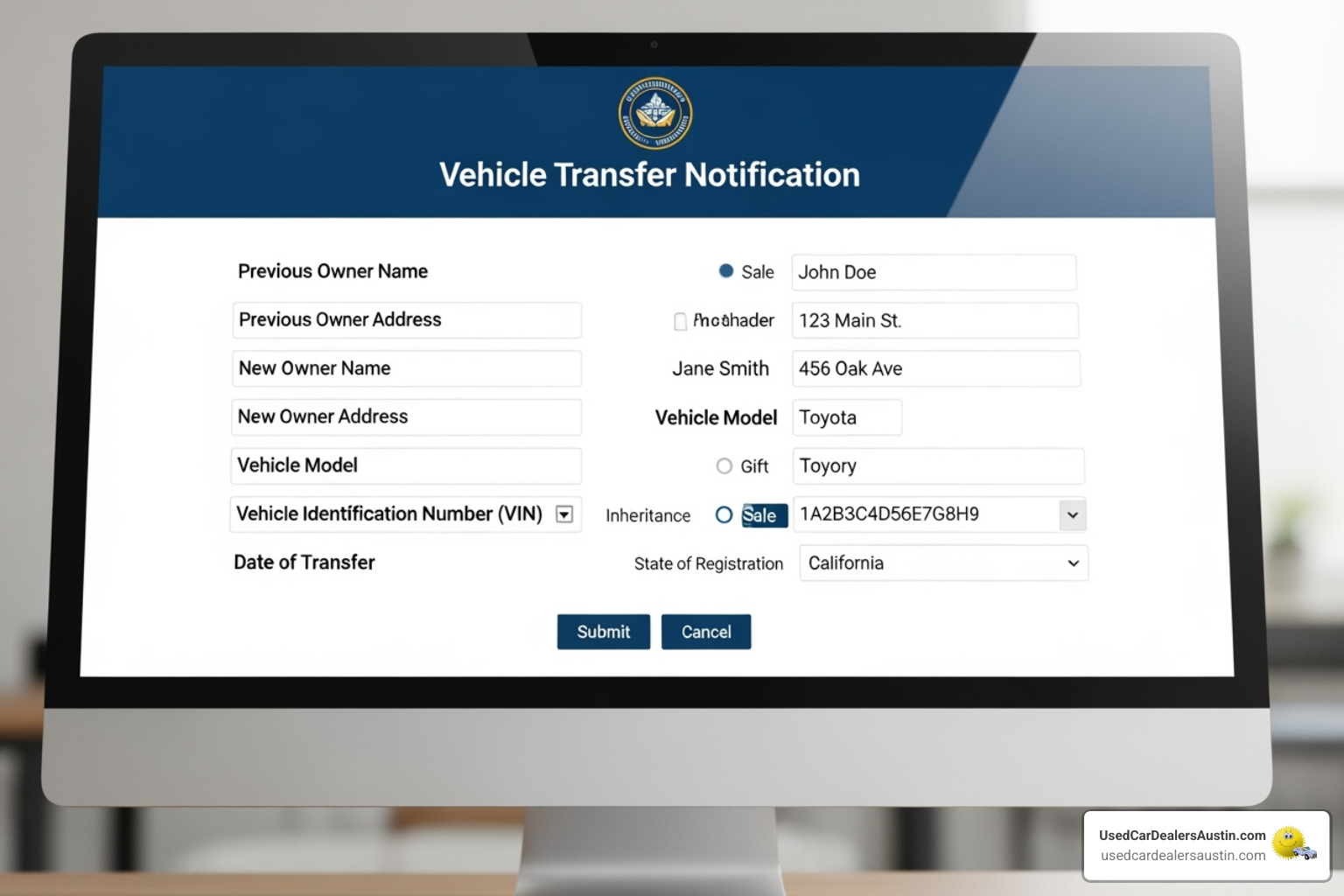
Here’s the reality: until the buyer completes their texas transfer title application and the state updates its records, that vehicle is still officially connected to your name. This means parking tickets could show up in your mailbox. Toll violations might hit your account. In worst-case scenarios, you could even be contacted about more serious legal issues involving the vehicle.
The VTN is your shield against these problems. Filing it within the 30-day submission window provides maximum protection, though you can still submit it later if needed. While it doesn’t actually transfer ownership (that’s the buyer’s responsibility), it formally notifies the state that you’ve sold the vehicle and should no longer be held responsible for what happens with it.
Why Filing a VTN is Crucial
Let’s be honest about what could go wrong if you skip this step. If the new owner doesn’t properly complete their title transfer, or if they delay it, you remain the owner of record in the state’s system. This creates a liability nightmare that’s completely avoidable.
Seller liability doesn’t magically disappear when you hand over the keys. Parking tickets, red-light camera violations, toll road charges, and even criminal activity involving the vehicle could potentially trace back to you. We’ve heard horror stories of sellers getting collection notices for unpaid tolls or even being contacted by law enforcement about incidents they had nothing to do with.
Post-sale violations are more common than you might think. Maybe the buyer doesn’t immediately register the vehicle, or perhaps they’re driving around with expired temporary tags. Either way, if something happens and the state’s records still show you as the owner, guess who might get that unpleasant phone call?
Updating TxDMV records through the VTN creates an official paper trail showing exactly when you sold the vehicle and to whom. This documentation can be invaluable if questions arise later. It’s your proof that you’re no longer responsible for the vehicle.
The best part? You can Submit a Vehicle Transfer Notification online in just a few minutes. It’s a small investment of time that provides enormous peace of mind.
How to Submit the Notification
Filing your Vehicle Transfer Notification is refreshingly straightforward. You have two main options, and both are designed to make your life easier.
Online submission is by far the most popular choice, and for good reason. You can complete the entire process through the TxDMV website in just a few minutes. The system walks you through each step, and your notification is processed immediately. No waiting for mail delivery or wondering if your paperwork got lost.
Mail-in option is still available if you prefer the traditional route. You’ll need to download Form VTR-346, fill it out completely, and send it to the TxDMV Vehicle Titles and Registration Division. Just remember that processing takes longer with mail, so you won’t have that instant confirmation.
Required information is pretty basic stuff you should have handy. You’ll need the vehicle’s VIN, the license plate number, the date you sold it, and the buyer’s name and address. The more complete information you provide about the new owner, the better your protection from future liability.
Here’s a pro tip: take a photo of the completed form before you submit it, whether online or by mail. Having your own record of what you submitted and when can be helpful if any issues arise later.
For additional guidance and resources about protecting yourself during the sale process, check out our helpful information at Tag: Transfer Your Used Car Title. When you buy from us at UsedCarDealersAustin.com, we handle all this paperwork for you, so you can focus on enjoying your new vehicle instead of worrying about forms and deadlines.
Fees, Timelines, and Special Scenarios
Let’s talk about the practical side of your texas transfer title application – what it’s going to cost you, how long you’ll be waiting, and what happens when life throws you a curveball.
The good news? Most fees are pretty straightforward. You’ll pay a basic application fee plus a $2.50 transfer fee to move the current registration to the new owner’s name. The bigger ticket item is the motor vehicle sales and use tax at 6.25%. This gets calculated on either the sales price (minus any trade-in allowance) or the Standard Presumptive Value of the vehicle – whichever is higher for most private-party sales.
If you’re one of the lucky ones receiving a vehicle as a gift from immediate family, you’ll only pay a flat $10 gift tax. New Texas residents bringing their own vehicle from another state face a $90 use tax instead of the standard sales tax.
Here’s where patience comes in handy: processing time runs a minimum of 20 business days. If there’s a lien on the vehicle, the lienholder typically receives the title first. Haven’t seen your title after 30 business days? Time to give the department a call.
Title corrections can be a bit tricky. If the TxDMV or county made the error, they’ll usually fix it for free. But if the mistake came from incorrect information on your application, you’re looking at a new application and fee to get it sorted out. Double-checking those forms really pays off!
Handling a Texas Transfer Title Application for Gifts, Divorce, or Death
Life isn’t always about straightforward car sales, and Texas recognizes that with specific procedures for special circumstances.
Gifting a vehicle between immediate family members requires more than just the usual paperwork. You’ll need to complete the Affidavit of Motor Vehicle Gift Transfer (Form 14-317) in addition to the signed title and Form 130-U. Both the person giving the gift and the recipient must sign this affidavit, and that $10 gift tax still applies.
Divorce situations depend heavily on what your divorce decree says. You’ll need a certified copy of the decree for the county tax office. If the decree clearly awards the vehicle to one spouse, that usually does the trick. Without clear language, you’ll need a properly assigned title from the ex-spouse. Pro tip: make sure vehicle ownership is crystal clear in your divorce paperwork!
When dealing with the death of a spouse, the process varies based on whether there’s a will. With a will, the vehicle typically goes through probate with the executor handling the transfer. Without a will, the Affidavit of Heirship for a Motor Vehicle (Form VTR-262) allows legal heirs to transfer the title.
These situations require extra care and attention, but following the specific guidelines ensures everything stays legal and smooth during what are often challenging times.
What is House Bill 718?
Change is coming to Texas vehicle transactions, and House Bill 718 is bringing some significant updates that affect how the whole system works.
Starting July 1, 2025, those familiar paper temporary tags are getting replaced with metal license plates. Instead of driving around with a temporary paper tag, vehicles will get a standard metal plate right from the start. This change aims to boost security and crack down on fraudulent temporary tag use that’s been a growing problem.
For dealerships like us, this bill mandates a complete shift to the webDEALER system for all title transfers by that same July 2025 deadline. This standardizes the process, improves efficiency, and creates a more secure, traceable system for vehicle ownership transfers.
While these changes primarily affect how we dealers handle the paperwork, it’s great news for buyers. You’ll benefit from an updated, streamlined system that makes your texas transfer title application more secure and efficient. Plus, you’ll get real metal plates instead of worrying about paper tags getting damaged or lost!
Conclusion
Congratulations! You’ve just mastered the ins and outs of the texas transfer title application process. It might seem overwhelming at first glance, but now you’re armed with the knowledge to handle any vehicle transfer situation that comes your way.
Think of this process like following a recipe – get the right ingredients (Form 130-U and the original title), follow the timing (that crucial 30-day deadline), and don’t skip the important steps. Miss one ingredient or ignore the timing, and you might end up with a costly mess instead of a smooth transaction.
The most important thing to remember? Time is your friend – but only if you respect it. That 30-day deadline from the date of sale isn’t a suggestion; it’s the law. File your application with your County Tax Assessor-Collector office promptly, and you’ll avoid those pesky late penalties that start at 5% and only get worse.
For sellers, here’s your golden rule: File that Vehicle Transfer Notification (Form VTR-346) as soon as you hand over those keys. Think of it as your “get out of jail free” card for any tickets, tolls, or troubles the new owner might create. It takes just a few minutes online, but it could save you months of headaches.
Don’t forget about the financial side either. Whether it’s the 6.25% sales tax, the $10 gift tax for family transfers, or the $90 new resident fee, knowing these costs upfront helps you budget properly. And if you’re dealing with special situations like divorce, inheritance, or gifting a vehicle, those extra forms we covered will be your lifeline.
Here at UsedCarDealersAustin.com, we understand that paperwork isn’t exactly anyone’s idea of fun. That’s why we take pride in handling all the texas transfer title application complexities for our customers. Our comprehensive in-house financing options mean we can help you get approved even with bad or no credit, offer low down payments, and provide competitive rates – all while our expert team manages the title transfer process behind the scenes.
We’re not just selling you a car; we’re providing peace of mind. Our certified used cars, trucks, and SUVs come with the confidence that all the paperwork will be handled correctly and on time. You can focus on the exciting part – enjoying your new ride around Austin and beyond.
Ready to skip the paperwork hassles and drive off with confidence? Find your next certified vehicle and let us handle the paperwork – because life’s too short to spend it at the DMV!